Introduction
A potential customer in Toronto types "best marketing agency for restaurants" into ChatGPT. The AI responds instantly, recommending three agencies, your competitor is listed first, with a detailed summary of their services and pricing. Your agency? Nowhere to be found.
This isn't a hypothetical future scenario. It's happening right now in 2026, and it's costing businesses customers every single day. Over 900 million people use ChatGPT weekly, and AI tools now generate 45 billion monthly sessions worldwide, 56% of global search engine volume.
The stakes have never been higher.
Traditional SEO alone no longer covers the full search landscape. AI answer engines like ChatGPT, Perplexity, and Gemini are now where 53% of U.S. consumers make purchasing decisions, and they pull from a completely different set of signals than Google's ranking algorithm. Being invisible in these AI-generated answers means losing customers to competitors who understand how to get cited.
What follows breaks down what Answer Engine Optimization (AEO) actually is, how each major AI platform selects its sources, and five concrete tactics to get your brand cited, starting today.
TLDR
- AEO is the practice of structuring content so AI platforms can understand, trust, and cite your brand in direct answers
- Being quoted inside an AI response is the goal, and once a competitor owns that slot, displacing them is significantly harder
- Three factors drive AI citation: how clearly your content is structured, how strong your third-party authority signals are, and whether AI crawlers can actually access your site
- AEO and SEO are complementary, strong SEO foundations contribute to AI visibility but aren't sufficient alone
- Most industries still have an open window for first-mover advantage, but it's closing fast as brands start paying attention
What Is AEO and Why Does It Matter More Than Ever in 2026?
Answer Engine Optimization (AEO) is the practice of engineering your content and digital presence so AI-powered platforms, ChatGPT, Perplexity, Gemini, and others, select your brand as the cited answer when users ask relevant questions. Unlike traditional search engines that return a list of links, these platforms synthesize one authoritative response.
The underlying technology shift driving AEO's relevance is Retrieval-Augmented Generation (RAG). Modern large language models (LLMs) increasingly run a live search, pull recent sources, and then summarize them. This makes real-time web content (not just static training data) the basis for most answers. Perplexity AI, for example, uses a multi-stage RAG pipeline that pulls approximately 60+ sources, with 70% of top citations updated within the last 12-18 months. The feedback loop from content change to AI visibility now measures in days or weeks, not years.
The scale of adoption confirms this is a mainstream channel, not an emerging experiment:
- ChatGPT processes over 2 billion daily queries and generates 5.35 billion monthly visits
- Perplexity handles approximately 780 million monthly queries, up 239% from August 2024
- Gartner predicts traditional search engine volume will drop 25% by 2026 due to AI chatbots and virtual agents, and that shift is already visible in traffic data across industries.
AI answers operate as zero-click environments. A user who gets their answer inside ChatGPT may never visit your website, but the brand cited in that answer has still shaped their decision. NerdWallet's Q4 2025 revenue rose 23% year-over-year to $225.4 million while facing "continued headwinds in organic search traffic", a clear example of brand influence decoupling from direct traffic.
For small and mid-sized businesses, the window is still open. Larger brands are investing in AEO, but they haven't locked up AI citations the way they dominate Google's top positions.
Research shows that 92.78% of pages cited by Perplexity have fewer than 10 referring domains. The playing field in AI results is significantly more level than in Google's domain-authority-weighted rankings, which means a well-positioned SMB can compete with a Fortune 500 for the same AI citation.
AEO vs. SEO: What Actually Changed and What Stayed the Same
Strong foundational SEO still contributes to AI visibility. Research shows that 54.5% of URLs cited in Google AI Overviews also appear in the top 20 organic search results, with overlap growing from 32.3% in May 2024 to 54.5% by September 2025. Clean site architecture, quality content, and authoritative backlinks still matter, they're now the floor rather than the ceiling.
The key divergence lies in success metrics. SEO is measured by ranking position and click-through traffic. AEO is measured by citation frequency, share of answer, brand mention rate, and sentiment accuracy in AI responses. A brand can rank #1 on Google and remain invisible in AI-generated answers if its content isn't structured for extraction.
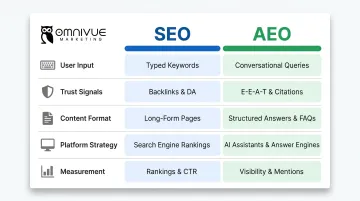
That difference plays out across every dimension of how these two disciplines operate:
The Core Differences Side by Side
| Dimension | SEO | AEO |
|---|---|---|
| User Input | Keyword-based queries (2–4 terms) | Conversational prompts and full questions |
| Trust Signals | Backlinks and domain authority | Citation authority, third-party mentions, E-E-A-T |
| Content Format | Whole-page optimization | Atomic chunk/snippet optimization, short, extractable units |
| Platform Strategy | Google-centric | Platform-specific (ChatGPT uses Bing's index; Perplexity shows explicit citations; Gemini rewards E-E-A-T signals) |
| Measurement | Rank tracking and traffic | AI visibility, citation monitoring, sentiment accuracy |
A quick note on terminology: LLMO (Large Language Model Optimization) and AEO are used interchangeably by most practitioners. LLMO emphasizes the underlying model layer; AEO is the more widely adopted term in marketing contexts. Both refer to optimizing for visibility inside AI-generated answers rather than traditional search result pages.
SEO drives traffic to your site. AEO builds brand presence at the moment someone asks an AI for a recommendation, often before they ever visit a search results page. In 2026, treating them as separate strategies means leaving half the funnel unattended.
How ChatGPT, Perplexity, and Gemini Actually Decide What to Cite
Not all AI platforms use the same retrieval method, and understanding the difference matters for your strategy.
ChatGPT relies on Bing's search index, if Bing doesn't have your page, neither does ChatGPT. Content that ranks well in Bing with strong structured data gets surfaced via the OAI-SearchBot, which performs real-time retrieval per query.
Perplexity shows cited sources in every response, making it the most transparent platform and the most useful for diagnosing your own visibility. It runs a multi-stage RAG pipeline pulling 60+ sources using hybrid BM25 and neural retrieval. The PerplexityBot handles search indexing separately from its training crawl.
Pages with JSON-LD schema (Person, FAQ, Article) have a 47% chance of Top-3 citation on Perplexity versus 28% without, the single highest-leverage technical change you can make.
Gemini draws directly from Google's search index and rewards content that performs well under Google's E-E-A-T framework. The Google-Extended crawler handles training data, distinct from Googlebot for search indexing.
The Three Gates Every Piece of Content Must Pass
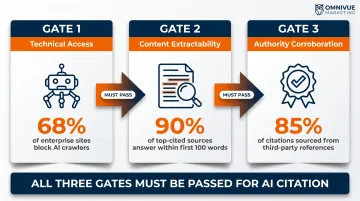
Despite their differences, all three platforms filter content through the same three checkpoints. Your content must clear all of them:
Technical Access, AI crawlers (GPTBot, ClaudeBot, PerplexityBot) must not be blocked by robots.txt or WAF configurations. Research found that 68% of 50 enterprise SaaS websites were inadvertently blocking at least one major AI crawler. Among news publishers, 67% block PerplexityBot and 62% block GPTBot.
Content Extractability, The page must contain clear, direct answers that can be pulled and summarized without ambiguity. 90% of top-cited sources provide the direct answer within the first 100 words.
Authority Corroboration, The brand or claim must be mentioned or validated by third-party sources that the AI platform already trusts. 85% of AI citations come from third-party sources, not brand-owned websites.
Diagnostic move: Run a Perplexity search for your own category, for example, "best marketing agency in Toronto", and study which sources appear. Those citations tell you exactly what content formats and authority signals the AI is rewarding. Build toward that profile.
The 5 AEO Tactics That Actually Get Your Brand Cited
1. Write for Extraction, Not Impression
AI systems parse for extractable, self-contained units of information. Every high-value page should open with a 30-to-60-word direct answer to the core question it targets, followed by short atomic paragraphs (1-3 sentences each).
Contrast these approaches:
❌ Vague brand language: "We deliver transformative solutions that revolutionize how businesses approach digital marketing."
✅ Specific extractable claim: "Omnivue Marketing builds AI-optimized digital marketing campaigns for SMBs in Toronto, Dubai, and North America, covering everything from website development to paid acquisition and AI search visibility."
Apply this structure to:
- Service pages: Lead with what you do, who you serve, and what outcomes you deliver
- About pages: State your core expertise and service areas in the first paragraph
- Blog posts: Answer the title question immediately, then expand with supporting details
NAM Rentals, a construction equipment rental company in Toronto, implemented this answer-first format for queries like "How much does scissor lift rental cost in Toronto?" Within six months, they achieved featured appearances in Google AI Overviews and a SEMrush AI Visibility Score increase from 0 to 14, with over 30 AI mentions across ChatGPT, Gemini, and Google AI Overviews.
That extractable content layer is what AI systems surface, but schema markup is what tells them what they're looking at.
2. Implement Schema Markup and Structured Data
Schema markup (JSON-LD) provides explicit semantic signals that help AI systems understand what a page is about without guesswork. JSON-LD is Google's recommended format and the most widely supported by AI platforms.
Most relevant schema types for SMBs:
- FAQPage: Maps directly to how users phrase questions in conversational AI interfaces
- LocalBusiness: Defines service areas, contact information, and operating hours
- Service, Specifies service offerings for entity recognition
- HowTo: Structures procedural content for step-by-step AI answers
- Article, Supports authorship and publication metadata for credibility signals
FAQ schema is particularly high-value. Pages using JSON-LD schema have a 47% chance of Top-3 citation in Perplexity, compared to 28% for pages without structured data.
3. Build Third-Party Citation Authority
AI platforms trust sources they have already encountered as authoritative. For a brand to be cited, it needs to be mentioned by those already-trusted sources. Analysis of 57 million AI citations found that 85% come from third-party sources, not brand-owned websites.
Where SMBs can build this presence:
- Industry review platforms, Google Business, G2, Clutch, Yelp (depending on vertical)
- Community platforms, Reddit discussions in relevant communities (Reddit is cited in 40% of AI answers); LinkedIn long-form articles
- Local media coverage, Press mentions, guest posts on recognized industry sites
- Journalist quote platforms, Qwoted, Featured, Help a B2B Writer (HARO shut down in December 2024; these are current alternatives)
Multi-platform multiplier effect:
- Brands present on 4+ platforms are 2.8x more likely to appear in ChatGPT responses
- Reddit or Quora mention multiplies citation likelihood by 4x
- G2, Capterra, or Trustpilot profile multiplies citation likelihood by 3x
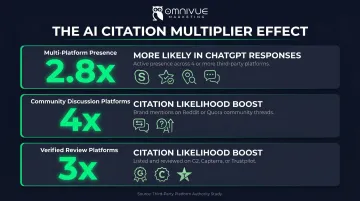
A brand that appears across multiple trusted third-party surfaces is perceived by AI as an established market player, not just a self-promotional website.
4. Optimize for Conversational Query Patterns
Users interact with AI platforms differently from Google. They use full questions, follow-up prompts, and context-rich language. AI Overviews appeared in 36.1% of queries that were 6-10 words long, but only 12.4% for 1-2 word queries.
How to structure content for conversational queries:
- Use question-based subheadings (H2s and H3s) that mirror natural questions
- Include explicit Q&A blocks
- Think about the "long tail of AEO questions", specific, scenario-based questions your target customers ask
Examples of conversational vs. keyword queries:
- Keyword: "marketing agency Toronto"
- Conversational: "What's the best marketing agency for a restaurant in Toronto?"
- Conversational: "How much does digital marketing cost for a small business in Toronto?"
Each question is a citation opportunity, but only if AI crawlers can actually reach the page where you've answered it.
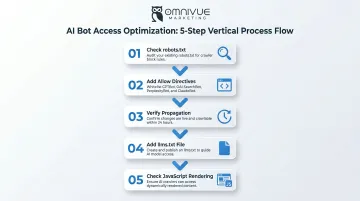
5. Verify AI Crawlers Can Access Your Site
Technical access is a prerequisite step. If AI crawlers can't reach your content, nothing else matters.
How to audit and fix crawler access:
- Check robots.txt, Navigate to yoursite.com/robots.txt and look for blocks against GPTBot, ClaudeBot, PerplexityBot
- Add explicit Allow directives if you find blocks:
User-agent: GPTBot
Allow: /

User-agent: OAI-SearchBot
Allow: /

User-agent: PerplexityBot
Allow: /

User-agent: ClaudeBot
Allow: /
- Verify changes propagate, Changes take within 24 hours to propagate
- Consider llms.txt, An emerging best practice for signaling LLM-specific access permissions (a plain-text file at yoursite.com/llms.txt)
- Check JavaScript rendering, Progressive JavaScript rendering can prevent AI crawlers from seeing content; static or server-rendered pages are preferable for AEO
For growing businesses without a dedicated technical team, Omnivue Marketing handles AEO and SEO together, auditing crawler access, implementing schema, and building content structured for AI citation, so neither discipline gets sacrificed for the other.
How to Measure Whether Your AEO Is Working
Traditional SEO metrics (rankings, organic traffic, CTR) are insufficient for measuring AI visibility. The relevant AEO metrics are:
- Visibility Score, How often your brand is mentioned in AI responses for target queries
- Citation Score, How often your domain URL is pulled as a source
- Sentiment Score, Whether AI responses describe your brand positively, neutrally, or negatively
- Accuracy Score, Whether the AI is representing your brand correctly and without hallucination
Practical Measurement Approach for SMBs
Start with manual testing. Run your target queries across ChatGPT, Perplexity, and Gemini weekly. Note whether your brand appears, how it's described, and which competitors get mentioned. Document exact queries and responses so you can track change over time.
Dedicated AEO monitoring tools:
- Profound, Tracks AI search intelligence across 10 AI engines (ChatGPT, Perplexity, Google AI Overviews, Gemini, Copilot, Claude, Meta AI, Grok, DeepSeek); pricing starts at $99/month
- Goodie AI, End-to-end AEO platform covering monitoring, content creation, and revenue attribution across 11 AI engines including Rufus (Amazon)
- Semrush AI Visibility Toolkit, Prompt Research tool and AI Search Visibility Checker; $99/month add-on to existing Semrush subscription
- Attribution-integrated monitoring, For teams that need AEO performance tied to actual revenue, look for platforms with cross-platform attribution modeling. Omnivue Marketing's OmniTrack Analytics Platform, for example, tracks how AI visibility influences the customer journey and connects brand citations to pipeline outcomes, helping teams understand which AI-driven touchpoints actually lead to conversions.
Visibility scores tell you whether AI engines see your brand. Attribution modeling tells you whether that visibility is driving revenue, and in a zero-click environment, that distinction matters.
Attribution Challenge in Zero-Click Environments
Because AI answers are zero-click or near-zero-click, direct traffic from ChatGPT to your site will undercount the actual influence of AEO. Build a more complete picture using:
- Post-purchase surveys, Ask "How did you hear about us?" with AI platforms as an option
- UTM-tagged links, For any AI-adjacent content or press mentions
- Assisted conversion modeling, Track touchpoints before conversion to see where AI interactions appear in the journey
Frequently Asked Questions
What is AEO in AI?
AEO (Answer Engine Optimization) is the practice of structuring content so AI-powered platforms like ChatGPT, Perplexity, and Gemini can understand and cite your brand as a trusted answer to user queries, rather than simply ranking your page in a list of links.
How does AEO differ from SEO?
SEO focuses on ranking pages for keyword-driven clicks while AEO focuses on being cited inside AI-generated responses. Both are necessary, SEO drives direct traffic, AEO builds brand presence in AI-mediated discovery and zero-click environments.
What is the difference between AEO and LLMO?
LLMO (Large Language Model Optimization) and AEO are used interchangeably by most practitioners and refer to the same discipline. Some use LLMO to emphasize the underlying model layer; AEO is the more widely adopted term in marketing contexts.
What are best practices for answer engine optimization in AI tools?
Write answer-first content with short atomic paragraphs, implement FAQ and schema markup, build third-party citation authority across review and media platforms, use question-based headings, and ensure AI crawlers are not blocked by your robots.txt.
What is the best software for answer engine optimization?
Look for tools that monitor AI citations across ChatGPT, Perplexity, and Gemini. Current options include Profound, Goodie AI, and the Semrush AI Visibility Toolkit, pick whichever covers your target platforms at a price that fits your budget.
Will SEO be replaced by AI?
SEO will not be replaced but will evolve. 54.5% of URLs cited in AI answers also rank in strong organic positions, meaning foundational SEO still underpins AI visibility. The difference is that SEO alone is no longer enough, AEO fills the gap it can't cover.