Introduction
Most small and mid-sized e-commerce stores are running PPC campaigns right now. Many are burning through budget with little to show for it. The ads run, clicks trickle in, and at the end of the month the numbers rarely justify the spend.
Campaigns fail for predictable reasons: poor setup, no ongoing optimization, or agencies that report activity instead of results. Before you allocate another dollar to paid search, the right question isn't how much you're spending, it's whether those dollars are driving profit or just traffic.
This guide covers what e-commerce PPC management actually involves: the structural decisions, ongoing optimizations, and the metrics that separate campaigns that convert from those that drain resources. You'll understand what makes a campaign profitable, how to track performance accurately, and when to bring in expert help versus handling it yourself.
TLDR
- You only pay when someone clicks, but profitability depends entirely on how the campaign is built and managed
- Keyword precision, conversion-focused copy, and matching landing pages determine whether clicks turn into revenue
- Track ROAS, CPA, and conversion rate to separate what's working from what's wasting spend
- PPC moves faster than SEO, but without active management, that speed becomes expensive fast
- Attribution gaps are a real problem, understanding which ads actually drive sales requires accurate cross-channel tracking
What Is E-Commerce PPC Management?
E-commerce PPC management is the continuous process of planning, launching, monitoring, and optimizing paid ad campaigns built specifically to drive online sales, not just impressions or clicks. Three parties are involved: the advertiser (your store), the ad network (Google Ads, Meta, Microsoft Ads, etc.), and the platform hosting the ad.
Campaigns demand ongoing attention across four core areas:
- Keyword reviews to capture intent and cut wasted spend
- Bid adjustments based on performance signals
- Ad copy testing to improve click-through and relevance
- Budget reallocation toward what the data confirms is working
Without this discipline, performance decays fast, and it decays faster in e-commerce than in most other verticals.
How the PPC Auction Works
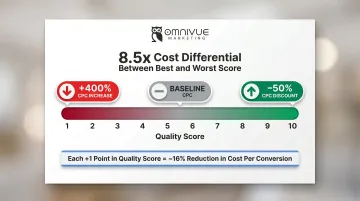
Advertisers bid on keywords, but placement isn't determined by budget alone. Ad position is calculated using bid amount combined with Quality Score, a 1-10 diagnostic measuring ad relevance, expected click-through rate, and landing page experience. A well-optimized campaign with strong relevance consistently outperforms a poorly structured one with a larger budget. Understanding this mechanic is why ongoing campaign management matters: it's where the efficiency gains live.
Quality Score drives cost efficiency: a score of 10 yields a 50% CPC discount versus baseline, while a score of 1 inflates CPC by 400%. That's an 8.5x cost differential between the best and worst performers. For every 1-point increase in Quality Score, cost per conversion decreases by approximately 16%.
Why E-Commerce Businesses Can't Afford to Ignore PPC
Speed: Immediate Visibility vs. Months of Waiting
PPC campaigns can generate traffic and leads within days of launch. SEO, by contrast, takes 3-6 months to show measurable improvements. When you're launching a new product, running a seasonal promotion, or entering a competitive market where organic rankings are hard to win quickly, PPC delivers the speed advantage you need.
Precision Targeting That Drives Revenue
PPC offers targeting capabilities unmatched by awareness channels: you can show ads based on search intent, purchase behavior, demographics, device type, location, and cart abandonment history. This is why PPC consistently outperforms broad channels when the goal is direct revenue.
The numbers back it up:
- 74% of brands call PPC ads a "huge driver" for their business
- 98% of businesses consider PPC a high priority
- Retail and e-commerce brands receive 23.6% of total traffic from paid search
Measurability: Connect Every Dollar to Revenue
Every click, conversion, and dollar spent is trackable. You can calculate ROAS at the campaign or product level, tie ad spend directly to revenue, and act on data that traditional advertising simply can't provide.
U.S. search ad revenue hit $102.9 billion in 2024, up 15.9% year-over-year, maintaining a 39.8% share of total digital ad revenue (IAB/PwC Internet Ad Revenue Report). Global search ad spend reached approximately $221 billion. With CPCs climbing year over year, e-commerce brands that run unoptimized campaigns are effectively paying more for less.
Retargeting precision: Paid search visitors are 35% more likely to convert than organic visitors. Customers exposed to retargeting ads are up to 70% more likely to purchase. With cart abandonment sitting at 70.19% across e-commerce, representing roughly $260 billion in recoverable U.S. revenue annually, retargeting and cart abandonment campaigns are critical PPC strategies.
The Key Components of a Winning E-Commerce PPC Campaign
Keyword Strategy and Match Types
Keyword research is the foundation. Get this wrong and you'll waste budget fast.
Match types determine how broadly your ads appear:
- Broad match: Widest reach, highest waste potential
- Phrase match: Moderate control, balances reach and relevance
- Exact match: Tightest control, lower volume but higher intent
Negative keywords are equally important, these are terms you explicitly exclude to prevent ads showing for irrelevant searches. An outdoor furniture store should exclude "indoor" or "DIY" to avoid paying for clicks that will never convert. Proper negative keyword management can eliminate 10-25% of wasted spend.
Long-Tail Keywords Convert at 2.5x the Rate
Long-tail keywords convert at 2.5x the rate of generic head terms. They account for over 91% of all web searches. While individual long-tail keywords have lower search volume, their aggregate volume is massive, and CPCs are generally lower due to reduced competition.
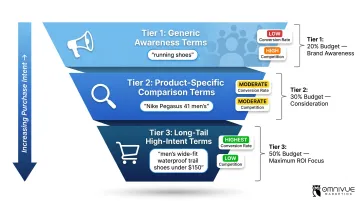
Three-tier keyword strategy:
- Generic terms for awareness: "running shoes"
- Product-specific terms for comparison: "Nike Pegasus 41 men's"
- Long-tail high-intent terms for conversion: "men's wide-fit waterproof trail shoes under $150"
Successful campaigns balance all three tiers and allocate budget proportionally based on profit margin strength. That keyword intent should be the first thing your ad copy reflects, matching the searcher's language at each tier directly improves click-through and conversion rates.
Ad Copy and Extensions
What makes e-commerce ad copy convert:
- Headlines including the target keyword
- Clear value proposition (free shipping, price match, same-day dispatch)
- Benefit-driven call-to-action
Ad extensions (sitelinks, callout extensions, price extensions, promotion extensions) are free ways to expand the ad's real estate on the SERP and improve CTR without additional cost per click.
Google's internal data shows ad extensions typically increase CTR by 10-15%. Image assets in Search increase CTR by 6% on average. Google recommends adding at least 4 sitelinks and 3 unique images as a baseline for each campaign.
Landing Page Alignment
The landing page is where the sale is won or lost. An ad promising a specific product discount must link to a page that delivers exactly that. Message mismatch kills conversions.
Key elements of a conversion-optimized landing page:
- Message match with the ad
- Clear product imagery
- Trust signals (reviews, guarantees)
- Prominent CTA
Dedicated landing pages convert 4-5x better than homepages for paid traffic. The median landing page conversion rate across industries is 6.6% (Unbounce, Q4 2024).
Sending PPC traffic to a homepage instead of a dedicated landing page is one of the most costly mistakes e-commerce advertisers make, and it directly drags down Quality Score, raising your CPC in the process.
Bidding Strategy
Two approaches dominate e-commerce bidding, and the right choice depends on where your campaign is in its data lifecycle:
| Approach | Best For | How It Works |
|---|---|---|
| Manual CPC | New campaigns with limited data | You set a max bid per click and adjust based on observed performance |
| Smart Bidding (Target ROAS / CPA) | Campaigns with 30+ monthly conversions | Google's machine learning adjusts bids in real time toward your profit targets |
Caution: Google's automation will spend your full budget regardless of profitability without proper guardrails like negative keywords, campaign segmentation, and margin-based targets. Smart bidding is powerful but requires oversight.
The Most Common E-Commerce PPC Mistakes (and How to Avoid Them)
Mistake 1: No Clear Campaign Goals Before Launch
Launching campaigns without defining whether the goal is revenue, new customer acquisition, or brand awareness leads to misaligned bidding strategies, wrong KPIs, and no way to evaluate performance. Tie goal-setting to choosing the right campaign type and bidding model from the start.
Mistake 2: Overly Broad Keywords Without Negative Keyword Lists
Broad keywords generate clicks from users who have no intent to buy, inflating CPC and tanking ROAS. A business selling premium leather bags getting clicks for "cheap bags" or "DIY leather bags" is burning money.
The average Google Ads account wastes 40-60% of its total budget on irrelevant searches, overbidding, and audience mismatches. Negative keyword gaps alone account for 25% of that waste. Audit yours monthly, even a quarterly review catches the terms quietly draining budget.
Mistake 3: Sending Traffic to the Homepage
When ad clicks land on a generic homepage rather than a product-specific page, bounce rates spike and conversion rates plummet. The user has to do the work your ad should have done. Each campaign or ad group should have a corresponding landing page that matches the ad's message and intent exactly.
Mistake 4: Setting the Budget and Walking Away
PPC campaigns decay quickly without regular oversight. Competitor bids change, Quality Scores fluctuate, seasonal demand shifts, and products go out of stock, all of which kill performance if no one is monitoring. At minimum, review these weekly:
- Budget pacing against targets
- Top-performing and underperforming keywords
- Conversion trends and cost-per-acquisition shifts
- Out-of-stock product ads still driving spend
Mistake 5: Not A/B Testing Ad Copy
Running a single static ad with no variation means leaving performance improvements on the table. Consistently testing two versions of headlines, descriptions, or CTAs allows campaigns to compound improvement over time. A headline test that lifts CTR from 3% to 6% on a $5,000/month campaign generates the same additional traffic as doubling your budget, at zero extra cost.
How to Track and Measure E-Commerce PPC Performance
Core Metrics Every E-Commerce Advertiser Must Track
| Metric | Definition | Healthy Benchmark (E-Commerce) |
|---|---|---|
| ROAS | Revenue generated per dollar spent on ads | 2.87:1 to 4.5:1 |
| CPA | Cost to generate one paying customer | $26.67 to $28.30 |
| CTR | Percentage of impressions that result in clicks | 6.97% |
| Conversion Rate | Percentage of clicks that result in a purchase | 2.81% to 3.22% |
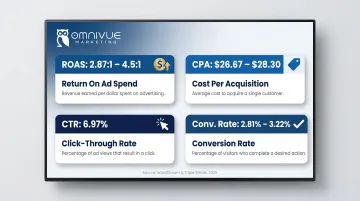
(WordStream 2025 benchmarks; Triple Whale 2025 data)
E-commerce has the lowest CPC among all industries ($1.16) but also a lower-than-average conversion rate, reflecting the browsing-heavy nature of e-commerce search traffic.
Why ROAS Isn't the Only Metric That Matters
A campaign with strong ROAS can still lose money if product margins are thin. Margin-adjusted ROAS corrects for this by factoring in your cost of goods before evaluating ad profitability. In practice, this means:
- A product with 80% margin needs a ROAS of only 1.25 to break even
- A product with 20% margin needs a ROAS of 5.0 to cover costs
- Gross profit contribution, not raw revenue, is the number that tells you whether a campaign is actually working
The Attribution Challenge Unique to E-Commerce
Customers often see multiple ads across multiple channels before converting. Standard last-click attribution models give all credit to the last ad clicked, often misrepresenting what actually drove the sale.
Standard tools fall short here. Most platforms misassign a significant share of channel credit due to last-click bias and cross-device gaps. Omnivue's OmniTrack Analytics Platform addresses this directly, using cross-platform modeling and machine learning to assign weighted revenue credit based on each touchpoint's position in the customer journey, giving e-commerce brands a concrete basis for budget decisions rather than educated guesses.
Monitoring Cadence: The Discipline That Separates Growth from Plateau
Daily: Budget pacing checks, anomaly detection
Weekly: Keyword performance reviews, bid adjustments
Monthly: Campaign audits for structural issues, budget reallocation
Quarterly: Strategic reviews to realign with business goals
Skipping even one layer of this cadence, especially weekly bid reviews, compounds into wasted spend that quarterly audits can't fully recover.
Should You Manage PPC In-House or Hire an Agency?
Who Should Manage PPC In-House
Businesses with a dedicated marketing hire who has PPC experience, relatively small and focused product catalogs, and enough time to monitor and optimize campaigns weekly can manage in-house successfully.
Warning: "Someone who can figure it out" is not the same as someone who has managed profitable e-commerce PPC at scale. The cost of learning with live ad spend can be significant.
When to Hire Outside Help
Consider hiring an agency or specialist when:
- Campaigns are underperforming despite investment
- The business is scaling into new markets or platforms
- There's no internal bandwidth for regular optimization
- Attribution complexity makes it impossible to understand what's actually working
The right agency should feel like an extension of your team, not another vendor to manage.
Agency Pricing: What to Expect
PPC agency fees vary by model and business size. Here's what to expect:
| Pricing Model | Typical Range |
|---|---|
| Flat monthly retainer | $1,500–$10,000/month (e-commerce typically $1,500–$8,000+) |
| Percentage of ad spend | 10–20% of monthly spend |
| One-time setup fee | $1,000–$5,000+ |
(NEWMEDIA, 2026; AgencyAnalytics, 2025; Stackmatix, 2026)
Under the percentage-of-spend model, a business spending $20,000/month on ads would pay roughly $2,000–$4,000/month in management fees.
The math matters: For an e-commerce business spending $5,000/month on Google Ads, 40–60% waste represents $2,000–$3,000/month in lost spend, often exceeding the cost of professional management. For most businesses spending $5,000/month or more, the breakeven math favors bringing in outside help, as long as waste reduction is the first thing they put on the table.
Omnivue's Model: The Lean Alternative to Traditional Agencies
Omnivue Marketing is a Google Partner collective of senior marketing professionals. There are no junior account managers, no drawn-out onboarding, and no bloated retainers, just direct access to people who have run campaigns inside global organizations and high-performance environments.
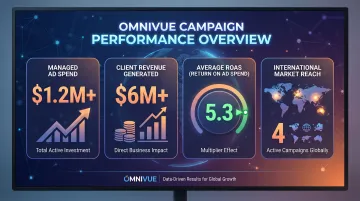
The track record is concrete:
- $1.2M+ in ad spend managed across Google and Meta
- $6M+ in revenue generated for clients
- 5.3 average ROAS across accounts
- Active campaigns across Canada, USA, Dubai, and India
Campaigns are built around high-intent audiences and optimized for ROAS and lead quality, not click volume or impression share. For founders who want results without the coordination overhead, that's the whole model.
Frequently Asked Questions
What is PPC in ecommerce?
PPC in e-commerce is a digital advertising model where a store pays only when a potential customer clicks on its ad. This makes it one of the most cost-controlled and measurable ways to drive online sales, provided campaigns are managed correctly.
What is PPC management in marketing?
PPC management is the ongoing process of planning, launching, monitoring, and optimizing paid ad campaigns. It covers everything from keyword selection and bid strategy to ad copy testing and performance reporting, ensuring campaigns remain profitable over time.
How much does a PPC agency cost?
PPC agency fees typically start around $1,500–$10,000 per month for management, separate from the actual ad budget. Pricing is either a flat retainer or 10–20% of ad spend, so evaluate what you're getting, reduced waste, better ROAS, and accurate attribution, relative to the fee structure.
Is PPC marketing worth it?
For most e-commerce businesses, yes, PPC gives you direct access to high-intent shoppers with spend you can control and revenue you can trace. The caveat is management quality: poorly run campaigns burn budget fast with little to show for it.
Is PPC better than SEO?
PPC delivers faster, measurable results while SEO builds long-term organic traffic. The strongest e-commerce strategies use both in combination: PPC captures demand now while SEO reduces reliance on paid spend over time.
Is PPC just Google Ads?
No. While Google Ads is the largest PPC platform, e-commerce PPC also includes Microsoft Ads (Bing), Meta (Facebook and Instagram), Amazon Sponsored Products, and others. The right platform mix depends on where your target customers are actively shopping.