Introduction
B2B SaaS companies are generating leads but still can't build a predictable pipeline. The real gap is a missing system that builds buyer awareness long before someone fills out a form. Less than 1% of leads convert to closed deals in most B2B organizations, a direct result of lead-centric processes that prioritize volume over quality.
The median SaaS sales cycle now spans 84 days, with buying committees averaging 13 internal stakeholders and 9 external influencers. These buyers consume 13.4 pieces of content before contacting sales, and 51% now start their research with AI chatbots rather than Google.
This guide walks through how B2B SaaS demand generation works as a full-funnel system, from defining demand to capturing, converting, and measuring it, so your pipeline grows on a reliable foundation rather than a lucky quarter.
TLDR:
- Demand generation builds awareness and trust; lead generation captures the interest that results from it
- Only 5% of your addressable market is actively buying at any time; demand gen ensures your brand is trusted when the other 95% enters evaluation mode
- ICP targeting, buyer-stage content, and marketing-sales alignment are the foundation of sustainable pipeline growth
- Demand gen now requires optimization for both traditional search and AI discovery engines like ChatGPT, Gemini, and Perplexity
- Track pipeline-influenced metrics, LTV:CAC ratio, and deal velocity rather than MQL volume to measure business health
What Is B2B SaaS Demand Generation?
B2B SaaS demand generation is the structured process of building awareness, interest, and buying intent among qualified accounts before they actively evaluate solutions. It shapes how buyers frame their problem and which vendors make the shortlist, before any RFP or demo request lands in your inbox.
The 95-5 Rule: Why Most Buyers Aren't Ready Yet
At any given time, only approximately 5% of your total addressable market is actively in-buying mode. This principle, articulated by Professor John Dawes of the Ehrenberg-Bass Institute, explains why demand generation is foundational to B2B SaaS growth. While Forrester notes that in B2B tech the in-market figure may be closer to 15-30% depending on category, the core insight remains: the vast majority of your potential customers are not ready to buy right now.
Demand generation ensures your brand is already familiar and trusted when buyers enter active evaluation. Without it, you're invisible to the 70-95% who will buy later, and those deals are lost before a conversation ever starts.
That "buy later" window is also harder to navigate than most marketers expect. B2B SaaS demand generation carries structural complexity that traditional sales models don't face:
What Makes SaaS Demand Gen Uniquely Complex
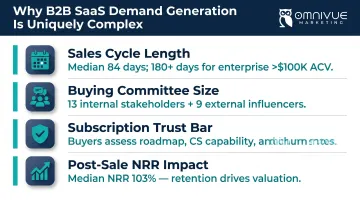
- Sales cycles run longer than most teams budget for: the median is 84 days overall, stretching to 180+ days for enterprise contracts above $100K ACV
- Buying committees have grown, the typical B2B tech decision now involves 13 internal stakeholders and 9 external influencers, each requiring different messaging
- Subscription pricing raises the trust bar: buyers assess product roadmaps, customer success capabilities, and churn rates before committing to an ongoing relationship
- Post-sale performance directly affects valuation, for bootstrapped SaaS companies with $3M-$20M ARR, median NRR sits at 103%, meaning expansion and retention aren't optional growth levers
Demand Generation vs. Lead Generation in SaaS
Demand generation creates the conditions for buying-awareness, education, trust-while lead generation captures interest once those conditions exist. Lead gen only works when demand gen has already done its job.
Core Distinctions
| Dimension | Demand Generation | Lead Generation |
|---|---|---|
| Goal | Create intent and buying readiness | Capture contact information from interested prospects |
| Timeline | Long-term market influence (months to quarters) | Mid-funnel acquisition (weeks to months) |
| Primary Metric | Pipeline influenced, content-assisted conversions | MQL volume, form fills, contact acquisition |
| Content Approach | Ungated educational content that builds authority | Gated assets designed to capture lead data |
Why the Distinction Matters
The most effective B2B SaaS companies treat lead generation as a conversion layer inside a broader demand generation system, not a standalone strategy. Chasing MQL volume without building demand first fills pipelines with poor-fit leads that never close. The difference shows up in three ways:
- Pipeline quality: Demand-first programs attract buyers already convinced of the problem-not just contacts who clicked a form
- Sales velocity: Pre-educated prospects move through deals faster because objections were handled upstream by content
- CAC efficiency: Organic intent driven by demand gen costs far less per closed deal than cold lead capture
Forrester research shows fewer than 1% of leads convert to closed deals, yet 39% of marketers still report lead quality and MQLs as their top metrics. Teams optimizing for MQL volume are, in effect, measuring the wrong thing, and their revenue numbers reflect it.
The Core Building Blocks of a B2B SaaS Demand Gen System
Effective demand generation is a connected system, five building blocks that reinforce each other:
- Revenue-qualified ICP
- Content engine aligned to buyer maturity
- Demand capture via SEO and paid media
- Nurture and lifecycle program
- Marketing-to-sales alignment around shared signals and definitions
Ideal Customer Profile: The Foundation
Most teams define ICP using only industry and company size-but those filters describe who a company is, not whether it's ready to buy. A revenue-qualified ICP layers in signals that identify accounts with genuine adoption readiness:
- Funding stage: Series A companies often have budget but limited infrastructure; Series B+ buyers evaluate more rigorously
- Hiring velocity: Companies adding headcount in relevant departments signal growth and potential need
- Tech stack compatibility: Existing tools indicate integration readiness and technical sophistication
- Growth rate: Revenue trajectory suggests urgency and capacity to invest
Precise targeting at this stage directly improves the quality of everything downstream. Poor ICP targeting creates massive pipeline waste-in one benchmark, 72% of a team's pipeline had no chance of closing. Rebuilding it from ICP-matched companies doubled their win rate.
Content Aligned to Buyer Maturity
B2B buyers consume an average of 13.4 pieces of content before contacting sales. Each piece should serve the buyer's actual thinking, not promote features.
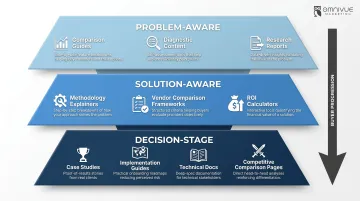
Top of funnel (problem-aware): Comparison guides ("Manual vs. Automated Workflows"), diagnostic content ("5 Signs Your CRM Is Slowing Sales"), and research reports that frame category urgency.
Mid funnel (solution-aware): Methodology explainers, vendor comparison frameworks, and ROI calculators that help buyers build internal business cases.
Bottom of funnel (decision-stage):
- Case studies with measurable outcomes
- Implementation guides that reduce perceived risk
- Technical documentation for evaluation teams
- Competitive comparison pages addressing specific objections
Account-Based Marketing for High-Value Accounts
Content moves individual buyers, ABM moves entire accounts. Rather than broadcasting to the broad market, ABM uses personalized content, coordinated outreach, and customized demos to engage specific decision-makers and buying committees simultaneously.
According to recent ABM benchmarks, the results are measurable:
- Tier-1 engagement lifts 3.4x compared to non-ABM cohorts
- Opportunity creation reaches 18% in targeted accounts
- Sales cycles compress by an average of 32 days
For SaaS companies with $50M+ ARR, 74% now run dedicated ABM platforms.
How to Build and Distribute Demand: Channels and Content Strategy
Building demand requires both creating content worth consuming and distributing it where the right buyers already spend time. Most SaaS teams underinvest in distribution relative to creation, limiting the impact of even excellent content.
SEO and AI Search Visibility
Organic search is one of the strongest intent signals in B2B SaaS-buyers actively researching solutions are already in a buying mindset. Historically, 90% of B2B researchers used search for business purchases, and today 80% of buyers still use Google somewhere in their buying journey.
Traditional SEO foundations:
- Keyword research aligned to buyer pain points (not just product features)
- On-page optimization with clear header hierarchy, internal linking, and metadata
- Building topical authority through consistent publishing in your category
- Earning backlinks from industry publications and partner sites
AI search optimization: 51% of B2B software buyers now start their research with AI chatbots more often than Google, and 71% rely on AI at some point in their research. More striking: 69% of buyers chose a different vendor than initially planned because of a chatbot's recommendation.
Teams that appear in AI-generated answers gain real visibility advantages over competitors relying solely on traditional SEO. Optimizing for AI discovery engines (ChatGPT, Gemini, Perplexity) requires a specific content approach:
- Structure content for direct-answer formats
- Use clear question-based headings
- Lead with conclusions before explanations
- Implement structured data (FAQ schema, HowTo markup)
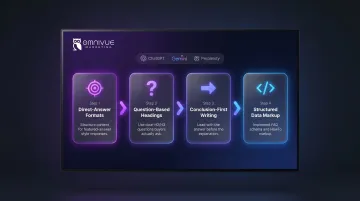
Running both traditional SEO and AI/GEO optimization together ensures your program captures demand regardless of where buyers start their research.
LinkedIn and Paid Social
LinkedIn serves as the primary B2B awareness channel, combining organic thought leadership to build authority with paid campaigns to expand reach within defined ICP segments.
Organic thought leadership: Executive content establishes credibility with decision-makers. Consistent posting builds familiarity before buyers enter active evaluation.
Paid campaigns: Sponsored content targets specific ICP segments using job titles, company size, industry, and seniority filters. Retargeting keeps your brand visible to warm audiences who have engaged with organic posts or visited your website.
LinkedIn advertising delivers approximately 113% ROAS for B2B SaaS companies, with an average cost per lead of $79.
Paid Search and Retargeting
Google Search ads capture high-intent demand from buyers actively using category-specific or competitor-comparison queries. For B2B SaaS, the median CPC for non-brand search campaigns is $8.50-$14.00, with median landing page conversion rates of 2.5-4.0%.
Retargeting extends your reach across the long B2B consideration window, reinforcing familiarity at the exact moment a buyer compares options. Paid search works best when it targets:
- Bottom-funnel category and comparison queries
- Competitor brand terms where you have a clear differentiation story
- Retargeting lists of site visitors segmented by page depth or content consumed
Repetition builds the trust that makes a brand feel "safe" to shortlist.
The Challenge of Multi-Channel Coordination
Each channel above works in isolation. The harder problem is running them together without fragmented messaging or wasted spend.
B2B SaaS companies without large in-house marketing teams often find that working with a single partner who owns the full funnel, from content creation to paid channel execution, removes the coordination costs that slow campaigns and erode budget.
Omnivue Marketing is built on this model: one team managing every channel from code to conversion, so founders get the output of an enterprise marketing function without the overhead of managing multiple vendors.
Converting Demand Into Pipeline: Nurture, Handoff, and Retention
Demand generation only delivers value when interest converts to pipeline and revenue. This requires structured nurture, clean marketing-to-sales handoff, and ongoing customer engagement.
Nurture and Lifecycle Marketing
Structured email sequences and lifecycle programs stay relevant to where a buyer is in their evaluation. Effective nurture adapts to behavioral signals rather than blasting generic messages.
Behavioral triggers that should adjust nurture flow:
- Page visits to pricing or case studies (indicates evaluation stage)
- Content downloads (signals topic interest)
- Webinar attendance (demonstrates active research)
- Email engagement patterns (open and click behavior)
Nurture moves buyers forward at their own pace, providing value at each stage rather than pushing for premature conversion.
Lead Scoring and Marketing-to-Sales Handoff
Marketing and sales need shared definitions to convert demand effectively. Build a lead scoring framework based on engagement depth, weighing demographic fit (ICP match) alongside behavioral signals like content consumption, product page visits, and time spent on pricing pages.
The handoff itself matters as much as the scoring. Sales should receive full context, content consumed, pages visited, pain points inferred from behavior, and engagement timeline, so the first conversation builds on what the buyer has already shown, rather than starting cold.
Bottom-of-Funnel Conversion
Four tactics consistently close the gap between interest and commitment:
- Tailor demos to the buyer's specific use case, a 30-minute focused walkthrough converts better than a generic product tour
- Use ROI calculators so buyers can build the internal business case with concrete projections
- Create time-bounded offers that add urgency without feeling coercive
- Lead with customer testimonials that address your most common objections directly
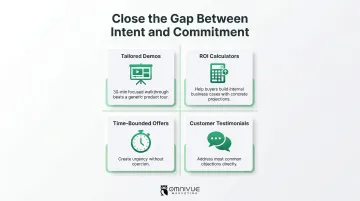
Each unnecessary step between intent and action erodes conversion rates. Audit the path from first contact to signed agreement and eliminate anything that doesn't move the deal forward.
Retention and Expansion as Demand Gen
The sale is not the finish line for demand generation. Ongoing customer engagement keeps users deriving value and reduces churn:
- Product tutorials and onboarding programs
- Customer success check-ins
- Feature announcements and education
- Community building and peer connection
For bootstrapped SaaS companies with $3M-$20M ARR, the median Gross Revenue Retention is 91%. Happy customers also become an organic demand gen channel through referrals and peer recommendations, compounding pipeline without additional ad spend.
Measuring B2B SaaS Demand Generation Performance
MQL volume is an incomplete-and often misleading-north star for demand generation. The metrics that actually reflect business health focus on revenue outcomes, not activity.
Revenue-Connected Metrics
| Metric | What It Measures | Why It Matters |
|---|---|---|
| Pipeline influenced | Dollar value of opportunities where marketing touched the deal | Shows demand gen's contribution to revenue, not just lead volume |
| Pipeline velocity | Speed at which deals move through stages (Opportunities × Deal Value × Win Rate ÷ Cycle Length) | Shorter cycles mean faster cash conversion and more efficient growth |
| Content-assisted conversions | Closed deals where specific content played a documented role | Identifies which assets actually accelerate buying decisions |
| Customer Acquisition Cost (CAC) | Total sales and marketing spend divided by new customers acquired | Lower CAC improves unit economics and extends runway |
| LTV:CAC ratio | Lifetime value divided by acquisition cost | David Skok's widely cited benchmark: this ratio should exceed 3:1 for healthy SaaS |
| Revenue attribution by channel | Which channels produce qualified pipeline and closed revenue | Replaces click-based proxies with actual business outcomes |
The Attribution Challenge
Accurate attribution separates demand gen programs that scale from those that plateau. When teams cannot confidently connect marketing activity to revenue outcomes, budget decisions become reactive and gut-driven.
That gap is measurable: most teams operate with significant attribution blind spots across channels. Closing that gap through cross-platform attribution modeling gives growth teams and leadership the confidence to make budget decisions based on actual pipeline contribution rather than assumed influence.
Why Measurement Frameworks Matter
A solid measurement framework lets teams identify which content accelerates deal velocity, which channels produce qualified pipeline, and where budget is being wasted. That clarity allows demand gen to build on itself rather than resetting with each campaign cycle.
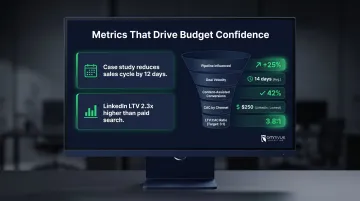
The practical difference is concrete: knowing a specific case study shortens sales cycles by 12 days means you produce more assets like it. Seeing that LinkedIn generates customers with 2.3x higher LTV than paid search means you shift budget accordingly. The result is demand gen that gets more efficient over time, not just busier.
Frequently Asked Questions
What is demand generation for B2B SaaS?
B2B SaaS demand generation is the process of building awareness, interest, and buying intent among qualified accounts before they actively evaluate solutions. It's distinct from lead generation because its goal is shaping buyer perception and establishing trust-not just capturing contact information.
What is the 95-5 rule for B2B?
The 95-5 rule describes how at any given time, only about 5% of your addressable market is actively in-market and ready to buy-the other 95% are not. Demand generation is the strategy for staying visible and trusted with that 95% so your brand is the obvious choice when they enter buying mode.
What is the 3-3-2-2-2 rule of SaaS?
The 3-3-2-2-2 rule is a SaaS growth benchmark for high-performing companies: triple ARR in years 1–2, then double in each subsequent year. It's a reminder that compounding growth requires a repeatable pipeline engine, not one-off campaigns.
How long does B2B SaaS demand generation take to show results?
Most demand gen programs begin showing pipeline influence within 60–90 days, but sustainable brand recognition and compounding pipeline growth require consistent execution across multiple quarters.
What metrics should I track for SaaS demand generation?
Prioritize pipeline influenced, LTV:CAC ratio (target 3:1 or higher), deal velocity, content-assisted conversions, and CAC by channel-these reflect actual business health far better than MQL volume or click-through rates alone.
Should B2B SaaS companies outsource demand generation or build it in-house?
The right choice depends on team capacity, expertise, and how quickly you need to move. Many Series A to mid-market SaaS companies choose an external partner to access full-funnel execution faster than hiring allows-especially when that partner owns all channels with integrated attribution rather than requiring multiple vendors.