Many B2B marketers face this exact disconnect: their SEO drives visibility, but the visitors who arrive aren't the decision-makers they need, aren't ready to buy, or disappear before converting. 71% of B2B researchers begin their buying journey with a generic search, yet most never engage with a sales rep because the content they find doesn't move them forward.
B2B SEO-driven lead generation isn't about traffic volume-it's about attracting the right decision-makers at the right stage of their buying journey and giving them a clear path to convert. This guide covers a full-funnel B2B SEO approach: from intent-driven keyword strategy and content mapping to conversion tactics and pipeline measurement that actually connects organic search to revenue.
TLDR
- Map SEO to each stage of the buyer journey, content and keywords that work for awareness rarely convert at the decision stage
- Target commercial intent keywords that reflect real buyer problems, not just high search volume
- Give decision-makers a reason to act: every piece of content needs a clear next step, proof, and a conversion path
- Measure success by lead quality and pipeline contribution, not vanity metrics like total traffic
Why B2B SEO Is Different from Regular SEO
B2B and B2C search behavior operate on very different timelines and decision structures. The average B2B software sales cycle takes 3-6 months for mid-market solutions and 9-18 months for enterprise deals. A B2B buyer searching for a solution is rarely ready to purchase on the first click-they're researching, building internal consensus, and comparing vendors across multiple stakeholders.
The buying committee itself reflects this complexity. The average B2B buying group consists of 6-10 stakeholders, with 89% of purchases involving two or more departments. Each stakeholder has different priorities, pain points, and questions-your SEO content needs to address multiple decision-makers, not just one.
This creates distinct keyword behavior. B2B queries tend to be specific, problem-framed, and lower-volume compared to B2C product searches. A B2B SaaS company targeting "enterprise workflow automation for manufacturing compliance" might see 150 monthly searches but represent six-figure deal opportunities.
A B2C productivity app chasing "best task manager" faces 50,000+ monthly searches but $10 purchases. Chasing high-volume keywords in B2B floods your site with unqualified traffic that never converts.
Qualified traffic in B2B is defined by three signals:
- Solution intent: The searcher is looking to solve a specific business problem, not browse general information
- ICP fit: The query reflects your ideal customer's industry, job role, or company size
- Funnel position: You can tell whether they're in early research, active evaluation, or final vendor selection
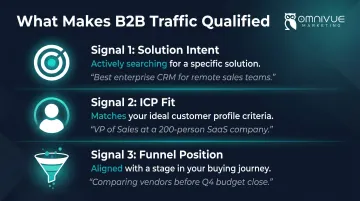
Traffic without these signals is noise, in B2B SEO, precision beats volume every time.
The Full-Funnel B2B SEO Framework
Treating SEO as only a top-of-funnel channel leaves significant pipeline opportunity on the table. Decision-makers at every stage, from initial problem recognition to final vendor selection, use search to inform their choices. B2B buyers are approximately 70% through their purchasing process before engaging with sellers, and in 81% of cases, they've already chosen a preferred vendor before talking to sales.
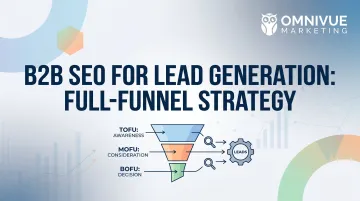
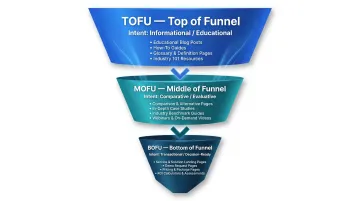
Your SEO strategy must map to three distinct funnel stages: awareness (TOFU), consideration (MOFU), and decision (BOFU). Each stage requires different content types, keyword targeting, and conversion goals, and collapsing them into a single approach means leaving qualified buyers unaddressed at every step.
Awareness Stage (TOFU)
TOFU SEO targets informational queries B2B buyers use when they first recognize a problem or challenge. A VP of Operations searching "how to reduce manufacturing downtime" is identifying a pain point, not evaluating vendors yet. This content builds brand familiarity and domain authority while positioning you as a trusted resource.
Ideal content types:
- Educational blog posts addressing specific industry challenges
- Industry trend guides and data reports
- Explainer articles breaking down complex concepts
- Glossary pages defining technical terms
TOFU content should still be ICP-qualified, generic traffic from students or job seekers doesn't convert. Internal links pointing toward MOFU content let engaged readers move deeper into the funnel on their own terms.
Consideration Stage (MOFU)
MOFU SEO targets commercial-intent keywords where buyers are actively comparing solutions or evaluating approaches. 41% of B2B buyers consume 3-5 pieces of content before engaging with a sales rep, and MOFU content is where trust converts into intent.
Ideal content types:
- Comparison pages (your solution vs. competitor or alternative approach)
- Case studies demonstrating outcomes for similar companies
- Industry-specific solution pages
- In-depth guides demonstrating expertise and process depth
- Webinars and interactive tools
Buyers at this stage are looking for evidence, not promises. Concrete case studies, specific methodologies, and measurable outcomes do more to advance a deal than broad capability claims.
Decision Stage (BOFU)
BOFU SEO targets high-intent, transactional queries from buyers close to making a vendor decision. A search for "enterprise contract management software demo" or "manufacturing ERP pricing" signals immediate buying intent. These pages must combine keyword optimization with conversion-focused design.
Ideal content types:
- Service landing pages optimized for specific solutions
- Demo request pages with embedded calendars
- Pricing pages (even if just to qualify budget expectations)
- ROI calculators that quantify potential value
BOFU pages need clear, specific CTAs. "Book a Strategy Call" or "Get a Custom ROI Analysis" consistently outperform generic "Contact Us" buttons because they set an expectation, not just an action. Every element on the page, headline, social proof, form length, should make it easier to say yes.
Intent-Driven Keyword Strategy for B2B Lead Generation
B2B keyword research must be organized around intent signals, not just search volume. The foundational question isn't "how many people search for this?"-it's "do the people searching for this match our ICP and have buying intent?"
Three intent tiers define your keyword strategy:
- Informational intent: Early-stage research queries ("what is workflow automation," "manufacturing compliance challenges")
- Commercial/investigational intent: Comparison and evaluation queries ("workflow automation vs. BPM software," "best compliance tools for manufacturers")
- Transactional intent: Decision-ready queries ("workflow automation demo," "enterprise compliance software pricing")
Analyze the SERP to identify intent. If Google returns blog posts and guides, it's informational. If it returns product pages, comparison charts, and demo landing pages, it's commercial or transactional.
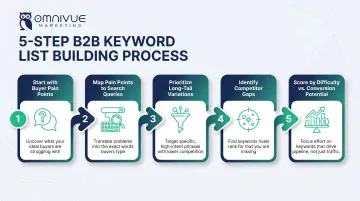
How to build a B2B keyword list:
- Start with buyer pain points: What problems does your ICP face? How do they describe these problems internally?
- Map pain points to search queries: Use tools like Ahrefs, SEMrush, or Google Search Console to identify how those problems are phrased in search
- Prioritize long-tail variations: Long-tail keywords have an average 36% conversion rate compared to 11.5% for head terms. "Enterprise workflow automation for pharmaceutical compliance" converts better than "workflow software"
- Identify competitor gaps: Analyze what queries drive competitor traffic and find underserved opportunities in your niche
- Score by difficulty vs. conversion potential: A keyword with 100 monthly searches, low competition, and high commercial intent beats a 10,000-volume generic term
Traditional keyword targeting, however, now covers only part of the visibility equation. A growing share of B2B buyers never reach Google at all.
Optimizing for AI search visibility:
84% of B2B CMOs now use AI tools like ChatGPT, Claude, and Perplexity for vendor discovery, with 68% starting their searches with AI tools before opening a traditional search engine. More B2B buyers are skipping Google altogether, asking AI tools "what are the best enterprise compliance platforms for pharmaceutical manufacturers?" and receiving curated vendor lists with zero website clicks.
Getting included in those AI-generated vendor lists requires a different approach than traditional SEO:
- Structure content around direct questions your buyers actually ask, AI systems pull from concise, clearly framed answers
- Use schema markup and explicit entity associations so AI tools can accurately categorize what you do and who you serve
- Build authority through digital PR and high-quality backlinks, consistent mentions on trusted platforms signal credibility to both AI and traditional search
Answer Engine Optimization (AEO) addresses exactly this gap, combining structured content with off-site authority signals to earn visibility in both Google results and AI-generated recommendations. It's increasingly where B2B discovery begins.
Converting SEO Traffic Into Qualified Leads
Traffic without a conversion path is a wasted investment. Every page-whether TOFU, MOFU, or BOFU-needs a deliberate visit-to-lead path that guides visitors toward taking action.
What makes a conversion-focused page in B2B:
- Specific, outcome-oriented CTAs: "Book a Strategy Call" beats "Contact Us." "Get a Custom ROI Analysis" beats "Learn More"
- Proof elements: Case studies, client logos, testimonials, and specific outcome metrics build trust
- Form design that balances capture with friction: Ask for enough information to qualify the lead, but not so much that visitors abandon
- Clear value proposition: What will the visitor get by converting? Be explicit
B2B landing pages achieve a median 6.6% conversion rate, with SaaS pages at 3.8%. If your pages underperform, audit for friction: unclear CTAs, slow load times, lack of social proof, or forms that ask for too much upfront.
Internal Linking as a Conversion Path
A well-structured internal linking architecture moves visitors from TOFU content into MOFU consideration pages and eventually toward BOFU conversion pages. Each link in the chain serves a purpose:
- Blog posts link to relevant case studies or solution pages
- Case studies link to demo or pricing pages
- Pricing pages link to booking or contact forms
This builds both SEO equity and buyer momentum. Visitors who consume multiple pieces of content before converting are more qualified and more likely to close.
Technical SEO and UX as Conversion Enablers
A B2B site that loads in 1 second has a conversion rate 3x higher than a site that loads in 5 seconds. As page load time increases from 1 to 3 seconds, bounce probability increases 32%. Fast page speed, mobile responsiveness, and clear navigation are not just ranking factors. They determine whether a prospect stays long enough to convert.
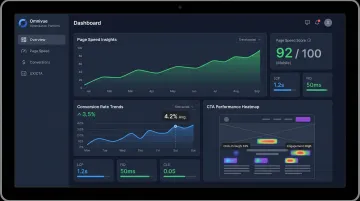
Omnivue Marketing handles this end-to-end, from site architecture and page speed optimization to CTA design and internal link strategy, so the traffic your SEO earns has a clear path to becoming pipeline.
Measuring B2B SEO Success the Right Way
Vanity metrics like total organic traffic and keyword rankings are insufficient in B2B. The right measurement framework connects SEO activity to pipeline.
Core KPIs for SEO-driven lead generation:
- Track TOFU, MOFU, and BOFU page visits separately to see where traffic concentrates by funnel stage
- Measure form completion rates on BOFU landing pages to gauge bottom-funnel conversion
- Monitor time on page and scroll depth for MOFU content, case studies and guides should show deep engagement
- Count MQL volume from organic to understand how many qualified leads search is actually producing
- Calculate your organic-to-close rate to see what percentage of organic MQLs become customers
- Compare cost per lead from organic vs. paid: SEO averages $14 per lead vs. PPC's $44, making the channel investment case straightforward
Only 31% of marketers are very confident in their current attribution models, and it's easy to see why. The average B2B conversion requires 14+ touchpoints from first contact to closed deal. Single-touch attribution misses most of that journey, which means most teams are measuring the wrong things.
Multi-touch attribution changes this. It increases B2B opportunity win rates by 18% and improves lead scoring accuracy by 32%. Omnivue's OmniTrack Analytics Platform applies this approach across every touchpoint, giving you a clear line from organic activity to pipeline and enabling confident budget decisions based on actual revenue contribution.
The timeline reality of B2B SEO:
SEO typically takes 3-6 months to show initial results, with meaningful lead volume appearing in 6-12 months. Unlike paid media, SEO is a compounding channel: early investments in domain authority, content, and technical optimization build momentum over time. By month 12, a well-executed B2B SEO program often generates more qualified leads per month than it did in the first six months combined.
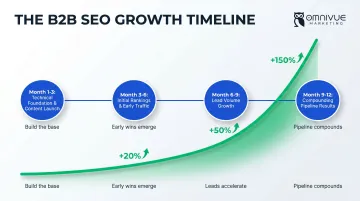
Treat SEO as a long-term asset, not a one-time campaign. Companies that invest consistently over 12-18 months typically see organic become their lowest cost-per-lead channel, and unlike paid media, it keeps producing after the budget stops.
Frequently Asked Questions
How to generate B2B leads for SEO services?
Target commercial-intent keywords that reflect real buyer challenges, create funnel-specific content mapping to awareness, consideration, and decision stages, and embed clear CTAs with lead capture forms on every SEO page. Proof elements like case studies and ROI calculators improve conversion rates for high-intent visitors.
How long does B2B SEO take to generate leads?
Expect initial traction in 3-6 months and meaningful lead volume in 6-12 months. SEO compounds over time, as domain authority builds, content gains rankings, and internal linking guides visitors through the funnel, results accelerate.
What is the difference between B2B and B2C SEO?
B2B SEO addresses longer sales cycles, multiple decision-makers, niche keyword volumes, and research-heavy buying processes. B2B keywords reflect specific problems and commercial intent rather than high-volume product searches, and content must support consensus-building across stakeholders rather than impulse conversions.
How do I measure the ROI of B2B SEO?
Track MQLs sourced from organic search, cost per lead, and revenue influenced by organic touchpoints. Attribution tooling is critical here, platforms like OmniTrack Analytics connect SEO activity to closed revenue across multi-touch journeys, giving you a clear picture of what's actually working.
What types of content work best for B2B SEO lead generation?
Match content type to buyer stage:
- TOFU (awareness): Educational blog posts, guides, and thought leadership
- MOFU (consideration): Case studies, comparison pages, and webinars
- BOFU (decision): Service landing pages, demo request pages, and pricing pages
Should B2B companies focus on SEO or paid ads for lead generation?
Paid ads provide immediate visibility and testing opportunities; SEO builds sustainable, compounding pipeline over time. The most effective B2B strategies run both, paid to capture high-intent demand now, SEO to reduce long-term acquisition costs.
Ready to turn your SEO traffic into qualified pipeline? Omnivue Marketing combines technical SEO, Answer Engine Optimization, and conversion-focused design to ensure your website attracts the right decision-makers and moves them toward action. From keyword strategy to attribution-backed measurement with OmniTrack Analytics, we handle the full funnel-code to conversion. Book a strategy call to discuss your B2B lead generation goals.