Introduction
Healthcare providers invest thousands of dollars each month in PPC campaigns, watch the clicks roll in, see the dashboard light up, and then wait for appointment bookings that never materialize. The budget evaporates, the phone stays quiet, and the agency's explanation is always the same: "We delivered the clicks."
The problem isn't that healthcare PPC is broken. It's that most campaigns are run like general retail efforts, optimized for clicks and impressions instead of patient trust, compliance, and actual appointments. Healthcare isn't e-commerce. Patients researching a surgeon, therapist, or specialist aren't impulse-buying. They're making high-stakes decisions that require trust, credibility, and clarity at every touchpoint.
This guide gives you a clear path from wasted ad spend to campaigns that actually fill your appointment calendar.
TL;DR
- Healthcare PPC charges only when patients click, targeting high-intent searches like "cardiologist near me"
- Google and Meta restrict health-based targeting; HIPAA governs how you track conversions
- Phone calls drive 47% of healthcare conversions, call tracking is non-negotiable
- Top channels: Google Search (highest intent), Meta (awareness/retargeting), Bing (older demographics)
- Winning campaigns need geo-targeting, trust-focused copy, dedicated landing pages, and solid attribution
What Is PPC Advertising for Healthcare Services?
PPC (Pay-Per-Click) advertising means healthcare providers pay only when a potential patient clicks their ad, not for exposure, not for impressions, only for engagement.
The real advantage is intent. Someone actively searching "cardiologist near me" or "urgent care open now" is signaling immediate need. That moment is where PPC earns its place in patient acquisition.
Core Platforms for Healthcare PPC
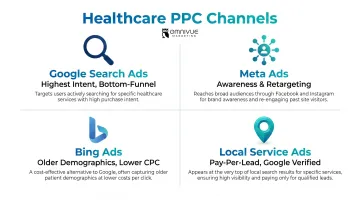
Google Search Ads are where most healthcare PPC budgets belong. Google holds 85.98% of the Canadian search engine market and 85.5% in North America overall. High-intent queries like "orthopedic surgeon Toronto" or "walk-in clinic open Saturday" signal readiness to book, Search Ads capture that moment directly.
Meta Ads (Facebook/Instagram) serve a different function: awareness and retargeting. Meta reaches patients before they're actively searching and reconnects with people who visited your website but didn't book. It's a relationship channel, not a pure intent-capture channel.
Bing Ads are often overlooked but cost-effective, especially for specialties targeting older demographics. 36% of Microsoft Advertising's search network users have household incomes in the top 25%, and 54% are married, ideal for family medicine, cardiology, and senior care.
Local Service Ads (LSAs) and YouTube video ads fill specific gaps the other platforms don't cover. LSAs operate on a pay-per-lead model and display a "Google Verified" badge that builds immediate trust, particularly effective for primary care, dental, and urgent care practices.
What PPC Is NOT
Understanding what each platform does helps clarify what PPC itself is, and isn't. PPC is not SEO, which builds visibility over months through content and authority. It's not organic social, and it's not display advertising bought by impression. Healthcare PPC is specifically about purchasing access to high-intent moments: the seconds when someone types "dermatologist near me" and decides which practice to call next.
Why Healthcare PPC Is Uniquely Complex
The Compliance Minefield
Google, Meta, and other platforms enforce strict policies around healthcare and pharmaceutical advertising. Condition-based targeting is restricted or prohibited across the board. Key platform restrictions include:
- Meta prohibits "sensitive personal data for ad targeting" and bans ads that assert or imply personal attributes like physical or mental health conditions
- Google frequently labels healthcare ads "Eligible (limited)", restricting where and how they appear
- Addiction services require LegitScript certification and a separate platform authorization before ads can run
HIPAA regulations govern how patient data can be tracked and used in ad campaigns. The HHS Office for Civil Rights confirms that Individually Identifiable Health Information (IIHI) collected on a regulated entity's website is generally Protected Health Information (PHI). Connecting an IP address to a webpage visit, like someone seeking a second opinion for a brain tumor, is a disclosure of PHI.
Standard conversion tracking setups used in e-commerce are often non-compliant in healthcare. Regulated entities must enter into Business Associate Agreements (BAAs) with tracking technology vendors to ensure PHI is protected.
Canadian providers also face CASL (Canada's Anti-Spam Legislation) requirements for email and SMS remarketing. Express or implied consent is required, pre-checked boxes are prohibited, and unsubscribe mechanisms must be honoured within 10 business days.
The Patient Trust Barrier
Unlike e-commerce, healthcare decisions are high-stakes and emotionally charged. A patient researching a surgeon isn't impulse-buying. Ad copy making exaggerated claims, "guaranteed results," "100% success rate", not only violates platform policies but actively destroys credibility with the exact audience you need to convert. Trust is the conversion currency in healthcare PPC.
The Cost Reality
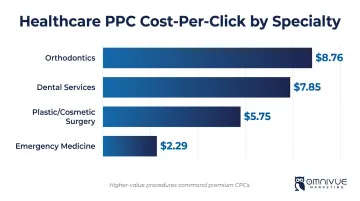
Healthcare is one of the most expensive PPC verticals. Current cost-per-click benchmarks show orthodontics at $8.76, dental services at $7.85, and plastic/cosmetic surgery at $5.75. Compare that to emergency medicine at $2.29 per click. High-value elective procedures command premium CPCs because patient lifetime value justifies aggressive bidding. Without proper management, a $5,000 monthly budget burns through 640 clicks, and generates zero booked appointments.
The Lengthy Patient Decision Cycle
A patient considering orthopedic surgery or fertility treatment may research for weeks or months before booking. A single click rarely converts immediately. Campaigns need to account for multi-touch patient journeys, remarketing sequences, and nurture strategies that keep your practice top-of-mind throughout the decision process.
The ROI Tracking Challenge
Many healthcare practices struggle to connect ad spend to real outcomes like booked appointments. Phone calls from ads, online booking completions, and contact form submissions all need proper tracking, but standard analytics setups often miss offline conversions entirely. 47% of consumers prefer phone calls when interacting with healthcare providers, and 48% of calls from digital marketing in healthcare are qualified leads. If you're not tracking phone conversions, you're missing nearly half your attribution data.
Choosing the Right PPC Channels for Healthcare
Google Search Ads: The Foundation
When patients are in active search mode, Google is where they go. 77% of patients use Google before scheduling an appointment. Search intent levels should guide your strategy:
- Informational queries ("what causes knee pain"), early-stage research; nurture, don't hard-sell
- Navigational queries ("Mayo Clinic orthopedics"), brand preference already formed; compete on visibility
- Transactional queries ("book orthopedic surgeon Toronto"), ready to convert; highest ROI for ad spend
Put the majority of your budget behind transactional keywords, that's where conversion rates are highest. Google Search Ads own the bottom of the funnel, but patients don't always start there.
Meta Ads: Awareness and Retargeting
Meta's value lies in reaching patients before they're actively searching, and pulling back those who visited your site but didn't book. That said, Meta has placed significant targeting restrictions on healthcare advertisers: health-based custom audiences are off-limits, and you cannot target by condition or health status.
Use Meta for:
- Building awareness of new services or locations
- Retargeting website visitors with appointment reminders
- Showcasing patient testimonials and trust signals
- Reaching specific demographics (age, location, parental status) without health condition targeting
Bing Ads and Local Service Ads
Beyond Google and Meta, two additional channels are worth budgeting for, especially for specialty practices targeting specific demographics.
Bing Ads offer lower CPCs and less competition. Bing's audience skews older, with 54% married and 59% having children at home, a strong fit for family medicine, senior care, and pediatrics.
Local Service Ads (LSAs) operate differently: you're charged for each valid lead rather than per click. Google displays a "Google Verified" badge for businesses that pass screening, building immediate trust with prospective patients.
Eligible specialties include allergists, chiropractors, dentists, dermatologists, dietitians, ophthalmologists, optometrists, orthodontists, physical therapists, podiatrists, and primary care providers. Note: booking leads and pre-badge ads aren't available for healthcare, you pay only for phone calls and messages from verified providers.
Building a Healthcare PPC Strategy That Converts
Keyword Strategy: Speak Patient Language
Patients do not use clinical terminology. They search "knee pain specialist," not "orthopedic surgeon specializing in chondromalacia patella." Structure your keyword strategy in three tiers:
Broad-intent (top-of-funnel):
- "knee pain treatment"
- "anxiety therapy options"
- "fertility clinic"
Medium-tail with modifiers:
- "anxiety therapist downtown Toronto"
- "family dentist accepting new patients Mississauga"
- "dermatologist evening appointments"
Transactional long-tail:
- "book same-day dermatologist appointment"
- "emergency dental clinic open Sunday"
- "OHIP-covered physiotherapy near me"
Negative keywords are critical too. Exclude terms like "free," "DIY," "salary," "courses," "jobs", searches with zero patient intent that drain budget fast.
Geo-Targeting and Campaign Structure
Healthcare decisions are driven by proximity. For general practitioners, a tight radius (5–10 km) makes sense. For rare specialists, fertility clinics, cosmetic surgeons, complex surgical procedures, widen the radius to 25–50 km or regional targeting.
Structure campaigns by service type and patient intent:
- Urgent/emergency campaigns: Higher bids, aggressive scheduling, call-focused
- Elective/planned procedures: Lower bids, longer nurture sequences, appointment booking focus
- New patient acquisition: Separate from existing patient retention campaigns
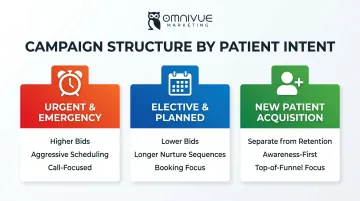
This allows different bidding strategies, budgets, and messaging for each patient journey stage.
Writing Ad Copy That Builds Trust
Healthcare ad copy must balance persuasion with accuracy. You cannot promise specific outcomes, but you can highlight credentials, patient experience elements, and empathetic language.
Effective ad copy includes:
- Credentials: "Board-certified dermatologist"
- Availability: "Same-day appointments available"
- Trust signals: "Accepting new patients," "20+ years experience"
- Empathetic language: "We understand chronic pain affects every part of your life"
Ad extensions amplify that copy without adding cost per click. Prioritize these four:
- Call extensions, 70% of mobile health searches end in a phone call, so click-to-call is essential
- Location extensions, surface your address and directions directly in the ad
- Sitelinks, link to specific services, patient testimonials, and insurance information
- Callout extensions, highlight trust signals like "OHIP accepted," "Free consultations," and "Virtual appointments available"
Landing Pages and Conversion Design
A PPC ad is only as good as the landing page it points to. Never send all ad traffic to your homepage. Each ad group or service should point to a dedicated landing page that matches the ad's message.
Every healthcare landing page must include:
- Clear service description in patient language
- Provider credentials and certifications
- Patient testimonials or social proof
- Transparent contact information (phone number above the fold)
- Visible, low-friction CTA: "Book Online" or "Call Now"
- Fast mobile load speed (under 3 seconds)
Message mismatch kills conversion rates. An ad promising "same-day appointments" that leads to a generic homepage with no booking CTA wastes every dollar spent on that click.
This is where many healthcare providers lose ground, the ad team and the web team aren't talking. Agencies like Omnivue Marketing manage the full path from ad click to landing page to booked appointment, keeping messaging consistent at every stage without the coordination overhead of multiple vendors.
Measuring and Optimizing Your Healthcare PPC Campaigns
Key Metrics That Actually Matter
Track beyond clicks and impressions. Focus on metrics tied to patient acquisition:
Cost Per Acquisition (CPA): What does it cost to get one booked appointment? If you don't know this number, you're managing blind.
Conversion Rate: What percentage of ad clicks become patient inquiries or bookings?
Benchmark ranges for healthcare PPC:
- Average CPC across healthcare: $5.00–$7.85
- Conversion rate: 7–12% (dentists average 9.08%, physicians/surgeons average 11.62%)
- Cost per lead: $70–$150 depending on specialty
Once you have these baselines, you have the data you need to make every budget and bidding decision deliberately.
Setting Up Conversion Tracking Correctly
Every healthcare PPC campaign must track four conversion actions:
- Phone calls from ads (requires call tracking integrated with Google Ads)
- Online appointment booking completions
- Contact form submissions
- Web chat initiations
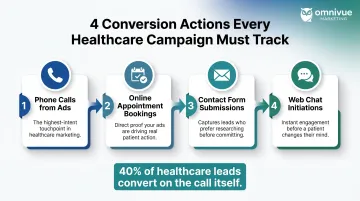
Standard Google Analytics setups frequently undercount healthcare conversions because so many happen offline or via phone. In healthcare, 40% of leads convert on the call itself. Attribution accuracy directly affects bidding decisions and budget allocation.
Omnivue's OmniTrack Analytics Platform addresses this gap directly, connecting phone call conversions, online bookings, and form submissions into a unified attribution view, so you know exactly which campaigns and keywords are driving booked appointments rather than estimating.
Ongoing Optimization Practices
With accurate attribution data in place, these three practices compound your results over time.
Run A/B tests on one variable at a time, headlines, CTAs, or landing page layouts. Wait a minimum of two weeks before drawing conclusions. Changing multiple elements at once makes it impossible to know what actually moved the needle.
Progress your bid strategy as data accumulates. Start with manual CPC or enhanced CPC to build a conversion history. Google recommends evaluating Smart Bidding over periods with at least 30 conversions (50 for Target ROAS). Once you hit that threshold, move to Target CPA or Target ROAS for better efficiency.
Apply the 80/20 rule to budget allocation. Put 80% behind proven high-converting campaigns, specific services, geo-locations, or keywords, and reserve 20% for testing new keywords, services, or ad formats. Review monthly and shift spend toward what's working.
Frequently Asked Questions
What does PPC stand for in healthcare?
PPC stands for Pay-Per-Click, a model where healthcare providers pay only when a potential patient clicks their ad, not for impressions or reach. You control spend directly based on actual engagement.
What are PPC services for healthcare providers?
Healthcare PPC services cover campaign setup, keyword research, ad copywriting, landing page optimization, and ongoing bid and conversion management. Campaigns typically run across Google, Meta, and Bing, targeting patients actively searching for care or building awareness in specific demographics.
How much do PPC services for healthcare providers cost?
Costs split into ad spend and an agency management fee. Small practices typically start with $2,000–$3,000/month in ad spend and scale from there. The number that actually matters is cost per acquired patient, not total spend.
Is PPC better than SEO for healthcare services?
PPC delivers immediate visibility while SEO builds long-term organic rankings over 6–12 months. They are complementary, not competing strategies. PPC is better for new practices, new service launches, or markets with immediate competition pressure. SEO provides sustained, lower-cost visibility over time once rankings are established.
What does a PPC manager do?
In healthcare, a PPC manager does more than run campaigns, they ensure everything aligns with platform policies (Google, Meta) and privacy regulations (HIPAA, CASL). Day-to-day, that means keyword research, ad copy, bid management, A/B testing, and conversion tracking.
Do healthcare PPC ads need to be HIPAA compliant?
The ads themselves don't collect health data, but the tracking infrastructure behind them must be carefully managed to avoid handling Protected Health Information (PHI). Remarketing audiences tied to health conditions are restricted, and your conversion tracking setup must not capture patient names, emails, or medical record numbers.