
Introduction
Most law firm websites don't have a content problem, they have an infrastructure problem. Well-written practice area pages and legal blog posts exist, yet they stall in search results and never appear in AI tools like ChatGPT or Google AI Overviews. The reason isn't quality, it's technical SEO.
Technical SEO is the foundational layer that determines whether search engines and AI systems can access, understand, and trust your content. For law firms, where Google's YMYL standards apply stricter quality thresholds, weak technical foundations are penalized more harshly than in other industries.
This guide is for law firm owners, managing partners, and legal marketing decision-makers. It covers the technical fundamentals, crawlability, site speed, structured data, Core Web Vitals, and site architecture, and explains how each one affects your visibility in both traditional search and AI discovery tools like ChatGPT and Google AI Overviews.
TL;DR
- Technical SEO is the infrastructure layer that controls whether search engines and AI systems can access, understand, and trust your site
- Law firms fall under YMYL classification, meaning stricter trust thresholds apply and technical weaknesses are penalised more harshly
- Core components include site architecture, Core Web Vitals, HTTPS security, mobile usability, schema markup, and E-E-A-T signals
- Schema markup (LegalService, LocalBusiness, Person, FAQ) remains one of the most underused tools in legal SEO
- Technical SEO directly affects whether your firm appears in AI-generated answers from ChatGPT, Gemini, and Perplexity
What Is Technical SEO for Law Firms?
Technical SEO is the process of ensuring your law firm website can be accessed, crawled, understood, and trusted by search engines and AI systems. It focuses on site structure, speed, security, and underlying signals, not the words on the page, but the infrastructure determining whether those words can ever rank.
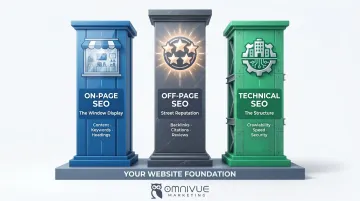
The three pillars of SEO each do a different job:
- On-page SEO is the window display (content, keywords, headings)
- Off-page SEO is your street reputation (backlinks, citations, reviews)
- Technical SEO is whether the building is structurally sound enough for anyone to enter
Understanding what technical SEO covers is only half the picture. How law firms actually manage it is where things tend to go wrong.
Many law firms treat technical SEO as a one-time setup during website launch. That's a costly misconception. Websites change, algorithms update, and new content creates new technical demands. A practice area page added without proper internal linking or schema markup becomes invisible to crawlers, regardless of how well-written it is.
Why Technical SEO Matters More for Law Firms Than Other Industries
YMYL Classification Creates Higher Standards
Google designates legal websites as "Your Money or Your Life" (YMYL) content, information that can directly impact legal rights, financial stability, or wellbeing. As a result, stricter quality and trust signals are applied before legal content is ranked or surfaced. A retail site with minor technical issues might still rank; a law firm site often will not.
Extreme Search Competition
Legal keywords are among the most competitive in any industry. Average cost-per-click for attorneys and legal services is $8.94, but top personal injury keywords routinely exceed $100 per click. High-stakes examples include:
- "Oilfield injury lawyers" at $620 per click
- "Tractor trailer accident law firm" at $500 per click
This extreme competition makes organic visibility through technical excellence a financial imperative.
Local Search Dependency
46% of all Google searches have local intent, and most legal services are searched geographically. Technical issues, poor mobile performance, inconsistent location pages, weak internal linking, directly suppress visibility in local pack results and Google Maps listings, where a significant share of client inquiries originate.
AI Discovery Filtering
AI tools like ChatGPT, Google AI Overviews, and Perplexity now answer legal questions directly. AI Overviews appear on 23.6% of legal queries and 57.9% of question-style legal queries. These systems prioritise sources that are not just relevant but structurally reliable and technically sound. The presence of an AI Overview reduces organic click-through rates for position one content by 58%.
Compounding Cost of Neglect
Technical SEO issues are often invisible to the firm but fully visible to search engines. A crawl error, a blocked practice area page, or a slow mobile experience can suppress rankings for months before anyone notices. By the time the drop shows up in traffic data, the damage to pipeline and lead volume is already done.
How Technical SEO Works: Core Components for Law Firm Websites
Technical SEO works by removing barriers between your content and the systems that evaluate it. Search engines and AI models send automated crawlers to discover, index, and interpret your site. Every component either helps or hinders that process, and any page a crawler can't reach simply won't rank.
Site Architecture and Crawlability
Site architecture, the logical organization of pages, internal links, and navigation, determines whether search engines can find and prioritise your most important content. For law firms, the hub-and-spoke model works best: a core practice area page (Personal Injury) links to sub-pages (Car Accidents, Slip and Fall, Workplace Injuries). This signals topical depth and makes the site easier for bots to map.
Technical components supporting crawlability:
- XML sitemaps submitted to Google Search Console so all practice area, location, and key content pages are discoverable
- Robots.txt file that tells crawlers what to access, firms commonly block key practice area pages by mistake
- Orphan pages with no internal links pointing to them are invisible to crawlers, identify and connect them to relevant practice area or location pages
Core Web Vitals and Page Performance
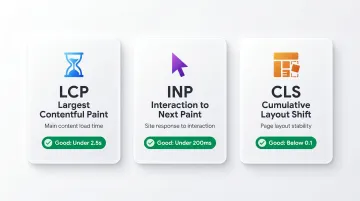
Core Web Vitals are formal Google ranking signals measuring real-world user experience. Three metrics matter:
| Metric | What It Measures | Target Threshold |
|---|---|---|
| Largest Contentful Paint (LCP) | How long main content takes to load | Under 2.5 seconds |
| Interaction to Next Paint (INP) | How quickly site responds to interaction | Under 200 milliseconds |
| Cumulative Layout Shift (CLS) | How stable page layout is during loading | Below 0.1 |
Law firm websites commonly fail Core Web Vitals due to:
- Heavy hero images or video headers
- Embedded PDFs for case results or attorney bios
- Cookie banners and third-party scripts from chat widgets and contact forms
- Complex multi-location sites with slow server response times
Only 48% of mobile websites and 56% of desktop websites achieved good Core Web Vitals scores in 2025. Google PageSpeed Insights and Google Search Console's Core Web Vitals report are the primary tools for identifying issues.
Mobile Usability and HTTPS Security
Google indexes the mobile version of a site first, which means poor mobile experience harms rankings across all devices. Mobile devices accounted for over 62% of global website traffic in 2024, making mobile performance non-negotiable for law firms.
Common law firm mobile issues:
- Dense text-heavy pages hard to scan on small screens
- Forms difficult to complete on mobile
- Phone numbers that aren't click-to-call
Security is the other half of this equation. HTTPS is a confirmed ranking signal, and for law firms handling sensitive client data, it directly affects trust as much as rankings.
Common HTTPS issues on law firm sites:
- Expired or misconfigured SSL certificates that trigger browser warnings
- Mixed content errors where secure pages load insecure resources
- HTTP pages left unredirected after migrating to HTTPS
Schema Markup, E-E-A-T, and AI Visibility: The Trust Layer Law Firms Overlook
Schema markup is structured code added to your website that tells search engines and AI systems what content represents, not just the words, but the meaning behind them. Without it, Google must infer context, which increases the risk of misinterpretation.
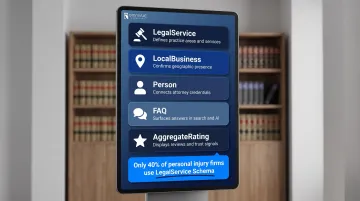
Most valuable schema types for law firms:
| Schema Type | Purpose |
|---|---|
| LegalService | Defines practice areas and services |
| LocalBusiness | Confirms geographic presence and office locations |
| Person | Connects attorney profiles to credentials and expertise |
| FAQ | Surfaces answers directly in search results and AI outputs |
| AggregateRating | Displays reviews and trust signals |
A 2026 study of 500 personal injury law firm websites found that while 67.6% implemented some JSON-LD, only 40.0% deployed the specific LegalService schema. For firms competing in high-intent local searches, that gap represents a concrete ranking opportunity.
E-E-A-T and Technical SEO
E-E-A-T (Experience, Expertise, Authoritativeness, Trust) is not a direct ranking algorithm but a set of quality signals Google's systems use to evaluate whether legal content can be trusted. Technical SEO directly supports these signals:
- Structured data linking attorney profiles to credentials
- HTTPS implementation
- Visible professional registration details in site footer and schema
- Outbound links to authoritative sources like law society or bar association websites
These same signals also shape how AI systems evaluate your content, which makes E-E-A-T implementation directly relevant to AI visibility, not just Google rankings.
How AI Systems Use Technical SEO Signals
AI models like ChatGPT and Perplexity extract and recombine information. Content is broken into usable components, not ranked as a whole page. To make it more likely that specific content elements are selected and surfaced in AI-generated answers, your site needs:
- Clean, semantic HTML structure
- Logical heading hierarchies (H1 -> H2 -> H3)
- Consistent schema markup with clearly attributed authorship
Pages built on visual page builders or embedding key content in PDFs are harder for AI systems to parse, and therefore less likely to be cited.
Schema implementation doesn't require a developer at every step. Tools like Google's Schema Markup Validator and WordPress plugins handle most use cases. Accuracy still matters, though: incorrect schema creates conflicting signals that can suppress rather than boost visibility. Firms with multiple office locations need to ensure their LocalBusiness schema matches their Google Business Profile exactly at each location, inconsistencies here directly affect local search performance.
Common Technical SEO Mistakes Law Firms Make
Most damaging structural mistakes:
- Location pages with near-identical content across multiple offices, creating duplicate content issues that dilute local visibility
- Key practice area pages with too few internal links pointing to them, making them hard for crawlers to discover and prioritise
- URLs changed without implementing 301 redirects, causing accumulated SEO authority to disappear entirely
These issues rarely get introduced deliberately, they're usually baked into how the site was originally built and compounded over time as the site grows.
The "Set and Forget" Misconception
Many law firms either never run a technical SEO audit or treat a one-time audit as permanent. That's a problem, because websites change constantly, content gets added, plugins update, third-party scripts accumulate, and new pages appear without following established URL conventions.
Industry best practice recommends comprehensive technical audits quarterly. Standard tools for this include:
- Google Search Console, flags indexing issues and manual actions
- Screaming Frog, crawls the full site for broken links, redirect chains, and missing metadata
- Semrush, identifies crawl errors, site health scores, and competitive gaps
For law firms without in-house technical marketing capability, a specialist team that handles the full stack prevents these issues from going unnoticed for months. Omnivue Marketing, for example, integrates technical SEO with content strategy and site development under one engagement, so structural fixes don't get siloed from the broader search strategy.
Frequently Asked Questions
What is technical SEO for law firms?
Technical SEO covers the infrastructure of a law firm website: site architecture, crawlability, speed, security, and structured data. It ensures search engines and AI systems can access, index, and trust the content. Without it, even well-written legal content may never rank.
Why do law firm websites fall under stricter SEO standards than other industries?
Law firm websites are classified as YMYL (Your Money or Your Life) content by Google, meaning stricter trust and quality thresholds apply. Technical weaknesses that might go unpenalised on a retail site can suppress rankings significantly on a law firm website.
How do Core Web Vitals affect a law firm's search rankings?
Core Web Vitals are formal Google ranking signals measuring load speed (LCP), interactivity (INP), and layout stability (CLS). Law firm sites frequently underperform due to heavy images, embedded PDFs, and third-party scripts. Hitting "Good" across all three metrics is recommended for competitive legal search terms.
What schema markup should law firms use?
The most valuable schema types for legal websites are LegalService, LocalBusiness, Person (for attorney profiles), FAQ, and AggregateRating. These help search engines and AI tools understand what a firm offers, where it operates, who its attorneys are, and how trusted it is.
Does technical SEO affect whether a law firm appears in AI-generated answers?
Yes. AI systems like ChatGPT, Google AI Overviews, and Perplexity use the same technical signals as search engines, but also evaluate source credibility more aggressively. Clean site structure, schema markup, named attorney attribution, and consistent crawlability all increase the likelihood of appearing in AI-generated legal answers.
How long does technical SEO take to show results for a law firm?
Quick fixes like crawl errors, HTTPS, and schema can show impact within weeks. Performance improvements like Core Web Vitals typically take 1-3 months. Structural changes such as site architecture and internal linking build impact over 3+ months as search engines re-crawl and re-index the site.