Introduction
The way buyers discover brands has fundamentally shifted. AI engines like ChatGPT, Gemini, and Perplexity now synthesize answers before users click a link-meaning brands invisible to these systems lose first-touch attribution regardless of their traditional search rankings. Research from Ahrefs shows that AI Overviews reduce click-through rates for position 1 by approximately 58%, which means ranking #1 no longer guarantees the traffic it once did.
In 2026, GEO has matured into two distinct tracks: software platforms for in-house monitoring and optimization, and full-service agencies that execute the entire strategy for you. Which fits depends on your team size, budget, and how much you want to own internally.
This guide breaks down the best options in both categories, with clear selection criteria and direct comparisons, so you can make the right call for your business stage.
TL;DR
- GEO makes brands visible inside AI-generated answers, not just traditional search rankings
- Two solution types exist: standalone tools for in-house teams and full-service agencies for end-to-end execution
- Top tools, SE Rankability, Peec AI, Writesonic, AthenaHQ, and Profound AI, vary by AI engine coverage, compliance features, and reporting depth
- Leading agencies (Omnivue Marketing, GenOptima, Go Fish Digital, WebFX) differ in pricing models, service scope, and which client sizes they serve best
- Choose based on team capacity, budget, and whether you need data insights, content execution, or both
What Is GEO and Why It Matters in 2026
Generative Engine Optimization (GEO) is the practice of structuring content so AI engines-ChatGPT, Google AI Overviews, Gemini, Perplexity-cite and recommend your brand in generated responses. Unlike traditional SEO (which targets page rankings) or AEO (which focuses on voice answer snippets), GEO measures brand mentions, citation frequency, and AI share-of-voice inside synthesized answers.
AI-generated answers now intercept high-intent queries across multiple platforms simultaneously. According to Semrush, AI Overview prevalence peaked at 24.61% in mid-2025 and settled at 15.69% by November 2025, while organic CTR for informational queries featuring AI Overviews fell 61% since mid-2024. Ranking on page one no longer guarantees visibility, the competition has shifted to which brands get cited in the answer itself.
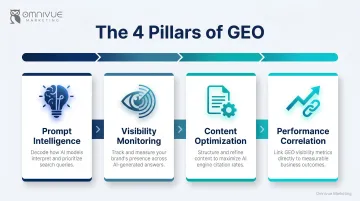
That shift is why GEO exists alongside SEO, not instead of it. Where SEO fights for position, GEO fights for citation. The four pillars are:
- Prompt intelligence: Understanding which queries trigger AI answers in your category
- Visibility monitoring: Tracking brand mentions across models in real time
- Content optimization: Structuring content for machine extraction and citation
- Performance correlation: Linking AI visibility changes to traffic and revenue outcomes
Best GEO Tools in 2026
These platforms serve teams that want to monitor, measure, and improve AI visibility in-house. They span monitoring-first tools, content optimization platforms, and full-stack SEO-plus-GEO solutions.
These platforms serve teams that want to monitor, measure, and improve AI visibility in-house. They span monitoring-first tools, content optimization platforms, and full-stack SEO-plus-GEO solutions.
Tools covered in this section:
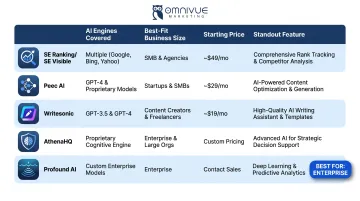
- SE Ranking / SE Visible, integrated SEO + GEO platform for agencies and in-house teams
- Peec AI, accessible entry-level monitoring for SMBs and growth teams
- Writesonic, content production combined with AI search visibility tracking
- AthenaHQ, competitive intelligence and ecommerce-focused GEO scoring
- Profound AI, enterprise-grade platform with empirical front-end interaction data
SE Ranking / SE Visible
SE Ranking is a widely used full-stack SEO platform. Its dedicated GEO add-on, SE Visible, tracks brand mentions, citation frequency, and competitive AI share across ChatGPT, Google AI Overviews, Gemini, Perplexity, and AI Mode. Its edge is embedding GEO metrics inside a broader SEO ecosystem, connecting AI visibility to traditional ranking signals, backlink growth, and content performance.
That integration turns GEO monitoring into a diagnostic system rather than a passive dashboard. Multi-language and multi-country support adds value for international teams managing localized AI visibility strategies.
| Key Features | Brand mention tracking, prompt-level monitoring, competitive AI benchmarking, unified SEO + GEO dashboards, white-label reporting | | Best For | Agencies and in-house SEO teams wanting integrated GEO and SEO data in one platform | | Pricing | SE Ranking Core from $103/month; SE Visible from $99/month; 10–14 day free trial |
Peec AI
Peec AI is an accessible entry-level GEO monitoring tool built for in-house marketing teams. It tracks brand mentions and competitor appearances across major AI engines with minimal setup and a clean, fast-to-interpret dashboard. Daily tracking updates enable quick signal detection when citation patterns shift.
Simplicity and low starting price make it the most practical first step for SMBs and growth teams establishing an AI visibility baseline before investing in full-stack platforms or agencies. Gap Analysis functionality reveals sources where competitors appear but your brand does not, so you can direct content efforts toward the highest-impact citation gaps first.
| Key Features | Prompt-based brand tracking, competitor source analysis, daily visibility updates, actionable gap recommendations | | Best For | Small to mid-sized businesses and in-house marketing teams starting their GEO journey with limited budget | | Pricing | Starter plan from ~$103/month (€89/month); 7-day free trial; custom enterprise plan available |
Writesonic
Writesonic approaches GEO from the production side. It helps teams create structured, answer-oriented content more likely to be cited by generative engines, while combining multi-platform tracking and citation gap analysis in a single workflow.
For marketing teams producing high content volumes, that combination removes the need to toggle between separate tools. The Action Center organizes optimization opportunities into Technical Issues, External Mentions, and Content Visibility, enabling rapid triage without external consultants.
| Key Features | Multi-platform brand tracking, Action Center for citation gaps, AI content generation, sentiment analysis, competitor benchmarking | | Best For | Marketing teams combining content production velocity with AI search visibility tracking | | Pricing | Starting from $79/month (annual billing); adds Gemini and AI Overviews at $199/month; 20% annual discount available |
AthenaHQ
AthenaHQ is a mid-market GEO platform focused on competitive intelligence and on-page optimization automation. It tracks prompt volumes, attributes AI search impact to website performance, and provides a unified GEO score quantifying standing across major LLMs.
Shopify integration and ecommerce-focused features differentiate it for product-driven businesses tracking revenue attribution from AI search. The Pitch Workspace gives agencies a ready-made environment for building client reporting around AI visibility metrics, without requiring custom development work.
| Key Features | GEO score, prompt volume tracking, source intelligence, Shopify integration, competitor benchmarking, sentiment tracking | | Best For | Ecommerce brands, data-driven agencies, and enterprise marketing teams attributing AI search to revenue | | Pricing | Self-Serve from $295/month; first month discounted; annual billing saves 17%; demo available |
Profound AI
Profound AI is an enterprise-grade AI visibility platform capturing real front-end interaction data across 10+ AI engines including ChatGPT, Claude, Perplexity, Gemini, Microsoft Copilot, and Google AI Mode. It provides empirical citation and crawler analytics rather than simulated outputs.
Query fanout analysis shows how AI engines expand user prompts into multiple search queries before generating answers, which explains why your brand appears in some responses but not others. SOC 2 Type II and HIPAA compliance make it the strongest option for regulated industries and large enterprises that need defensible, audit-ready AI visibility data.
| Key Features | 10+ engine coverage, query fanout analysis, shopping analysis, Profound Agents for AEO workflows, enterprise security compliance | | Best For | Enterprise organizations, regulated industries (healthcare, finance), and agencies managing high-profile clients | | Pricing | Starter from $99/month; Growth from $399/month; Agency Growth at $1,499/month; enterprise custom plans available |
Best GEO Services & Agencies in 2026
These full-service providers execute GEO strategy end-to-end-including content production, structured data implementation, citation monitoring, and AI engine-specific optimization. They're best suited for businesses lacking in-house resources or expertise to manage GEO independently.
Omnivue Marketing
Omnivue Marketing is a lean collective of senior marketing professionals serving startups through Inc. 500 companies across North America, Dubai, and India. Their GEO service optimizes brand presence for both traditional search and AI discovery engines including ChatGPT, Gemini, Perplexity, and Google AI Overviews-without traditional agency overhead.
The "one team owns the entire funnel" model means GEO strategy, content optimization, and performance tracking are managed cohesively rather than fragmented across vendors.
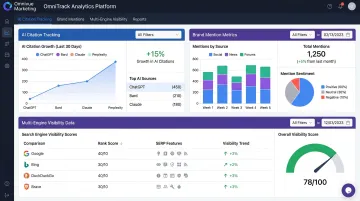
GPT-5 powered content optimization and the proprietary OmniTrack Analytics Platform, which ties AI citation performance directly to traffic and revenue outcomes, make this a measurable choice for SMBs wanting enterprise-quality GEO without enterprise cost.
Documented results include NAM Rentals achieving 30+ AI mentions across ChatGPT, Gemini, and Google AI Overviews within six months. The company went from zero AI citations to appearing alongside national competitors like United Rentals and DOZR-featuring in responses for queries like "affordable scissor lift rental Toronto" and "best scissor lift rental Toronto."
| Key Features | Full-funnel GEO + SEO integration, AI discovery engine optimization (ChatGPT, Gemini, Perplexity, AI Overviews), GPT-5 content recommendations, OmniTrack Analytics, cross-continent team execution |
| Best For | Small and mid-sized businesses, founders, and Series A startups needing enterprise-quality GEO without traditional agency friction or cost |
| Pricing | Lean retainer model; contact Omnivue for tailored engagement scope |
GenOptima
GenOptima is a GEO-native agency operating on a Result-as-a-Service (RaaS) pricing model-tying fees directly to measurable AI citation outcomes rather than hours billed. The agency covers seven major AI engines and uses proprietary daily monitoring infrastructure to track citation performance across ChatGPT, Perplexity, Copilot, Gemini, AI Overview, Grok, and AI Mode.
Its "citation engineering" methodology reverse-engineers the content formats each AI engine prefers, then produces content matched to those patterns at scale. For brands that want to pay for documented outcomes rather than effort, this outcome-linked model offers direct accountability. Structured data deployment emphasizes stacked JSON-LD Schema including Article, ItemList, FAQPage, and Organization markup.
| Key Features | 7-engine coverage, RaaS outcome-based pricing, daily citation monitoring, per-engine content strategy, structured data injection (ItemList, FAQPage, Organization schema) |
| Best For | Brands wanting performance-linked GEO pricing and documented citation outcome gains rather than standard retainer models |
| Pricing | Result-as-a-Service (performance-based); custom quotes based on citation scope |
Go Fish Digital
Go Fish Digital is a technical SEO and digital PR agency extending into GEO with a research-first approach. The agency incorporates Google patent analysis into content structuring decisions and builds "citation-eligible link profiles" through authoritative backlink campaigns that AI engines rely on as source signals.
For brands where domain authority and technical site architecture are primary barriers to AI citation, Go Fish Digital's combination of structured data deployment, crawl optimization for AI user agents, and link-earning content campaigns addresses root causes at the technical level. The proprietary Barracuda technology enables structural site analysis for AI crawler optimization.
| Key Features | Patent-informed GEO strategy, digital PR for AI-citable backlinks, structured data deployment, AI crawler optimization, technical SEO foundation |
| Best For | Enterprises with complex site architectures and authority gaps limiting AI citation eligibility |
| Pricing | Retainer-based; custom quotes |
WebFX
WebFX is a large-scale full-service digital agency with 1,000+ employees integrating GEO as an add-on within broader SEO, PPC, and content marketing packages. The proprietary MarketingCloudFX platform tracks AI search visibility metrics alongside traditional performance KPIs.
Operational scale allows rapid schema deployment and content restructuring across large site libraries simultaneously-making it practical for mid-to-large businesses needing GEO compliance across an existing high-volume content footprint without engaging a separate specialist. Real-time LLM monitoring across 10 AI platforms enables competitive benchmarking and citation tracking.
| Key Features | GEO integrated with SEO/PPC/content, MarketingCloudFX analytics platform, bulk schema deployment, content restructuring at scale |
| Best For | Mid-to-large businesses seeking GEO bundled within an existing full-service digital marketing engagement |
| Pricing | Retainer + performance hybrid; custom quotes based on service scope |
How We Selected These GEO Tools and Services
The most common mistake businesses make when assessing GEO solutions is selecting tools based on brand recognition or feature lists rather than whether the platform tracks real AI outputs versus simulated visibility scores. Many platforms rebadge traditional SEO dashboards under "GEO" terminology without offering genuine prompt-level monitoring.
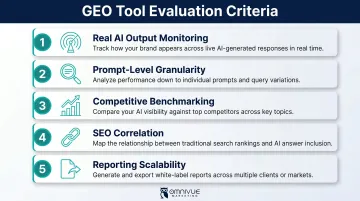
Tool Evaluation Criteria
- Real AI output monitoring: Captures actual AI-generated responses across multiple engines, not simulated projections or estimated visibility scores.
- Prompt-level granularity: Segments by intent type and query variation so you can see exactly which prompts drive citations.
- Competitive benchmarking: Shows relative share-of-voice in AI answers, surfacing citation gaps versus competitors.
- SEO correlation: Connects AI visibility to traditional ranking signals, backlinks, and content performance in one view.
- Reporting scalability: Exports data flexibly for client or stakeholder reporting across teams and agencies.
Evaluating agencies requires a different lens. Where tools are assessed on data fidelity, services need to demonstrate execution discipline and accountability across the full citation cycle.
Service Evaluation Criteria
- AI engine coverage breadth: Agencies covering 5+ engines scored higher; single-platform specialists carry more risk since citation behaviors vary widely by model.
- Measurement rigor: Can they show prompt-level citation data, or do they rely on anecdotal reporting?
- Pricing model accountability: Whether retainer or outcome-based, the agency should tie fees to documented citation gains, not just deliverables.
- Content production velocity: Semrush data shows 35% of new pages are cited within two weeks, but SISTRIX research reveals Google replaces 56% of sources weekly, fast, continuous content refresh isn't optional.
- Structured data expertise: Deploys comprehensive schema markup (FAQPage, ItemList, Organization) shown in structured data testing to improve machine readability.
Conclusion
The right GEO solution depends on team capability and business stage. If you have in-house resources to act on monitoring data, start with lean tools like SE Visible or Peec AI to establish baselines. If you need full execution support, full-service partners who own the funnel-strategy, content, structured data, and analytics-deliver faster results without coordination overhead.
The right starting point also depends on your scale:
- SMBs typically benefit from a monitoring tool or integrated full-service partner that handles execution from day one
- Enterprises often need dedicated analytics infrastructure first, then layer in agency execution for content and technical work
The choice isn't binary. Many businesses use monitoring tools for internal visibility while partnering with agencies for high-stakes content production and technical implementation.
For small and mid-sized businesses that don't want to stitch together separate tools and agencies, Omnivue Marketing's full-funnel model handles GEO alongside SEO, content, and analytics under one team, so growing companies get consistent execution without managing multiple vendors. Reach out for a tailored assessment of your current AI visibility gaps and a roadmap matched to your business goals.
Frequently Asked Questions
What is the difference between a GEO tool and a GEO service?
GEO tools are software platforms for monitoring and measuring AI visibility in-house, providing data dashboards and competitive benchmarking. GEO services are agencies that build and execute strategy end-to-end including content production, structured data deployment, and citation growth campaigns. Most businesses need one or both depending on internal capacity and strategic ambition.
How is GEO different from traditional SEO?
SEO targets algorithmic page rankings in search results, optimizing for clicks and traffic. GEO targets how AI engines process and cite brands inside generated answers, measuring brand mentions, citation frequency, and AI share-of-voice rather than position. The two disciplines complement each other: strong SEO foundations improve GEO eligibility, while GEO extends visibility into zero-click AI answer experiences.
Which AI engines do GEO tools typically monitor?
Most leading GEO tools in 2026 cover ChatGPT, Google AI Overviews, Gemini, and Perplexity at minimum. Advanced platforms extend to Microsoft Copilot, Claude, Grok, and Google AI Mode. Multi-engine coverage matters because citation behaviors differ drastically by platform-Claude relies on user-generated content 2-4x more than competitors, while Gemini shows the strongest preference for first-party websites.
Do small businesses need GEO optimization in 2026?
Yes. SMBs often lack the domain authority and content volume large brands have built over years, making them especially vulnerable to AI visibility gaps. Starting with a lean monitoring tool or a full-service GEO partner is practical and accessible before competitors lock up AI answer real estate in your category.
How long does it take to see results from GEO?
New GEO-optimized content can begin generating AI citations within days of publication. Semrush found that 35% of new pages are cited by AI search platforms within two weeks, rising to 42% by day 30. However, sustainable visibility requires ongoing content production-citation rates for static pages decay rapidly, with Google replacing 56% of sources weekly and ChatGPT replacing up to 74%.
Can I do GEO without an agency?
In-house GEO is possible using tools like those listed in this guide, but requires expertise in structured data, AI-calibrated content strategy, and consistent monitoring across multiple engines. Businesses without dedicated marketing resources typically see faster results working with a GEO service provider who handles strategy, execution, and performance tracking in one place.