Introduction
Many businesses today invest heavily in SEO to rank on Google, only to watch potential customers bypass their links entirely. Why? Because buyers increasingly turn to AI tools like ChatGPT, Perplexity, and Gemini first, platforms that generate direct answers without requiring users to click through to websites. Research shows that ChatGPT has surpassed 900 million weekly active users, and Google AI Overviews now appear in nearly 50% of tracked search queries, pushing zero-click search rates from 54% to 72%.
This shift creates a visibility crisis: brands that only optimize for traditional search rankings are losing exposure before anyone even sees their link. Answer Engine Optimization (AEO) bridges this gap by structuring content so AI systems cite and surface your brand inside generated answers, not just in a ranked list of links.
This guide covers what AEO is, why it matters for growing businesses, and concrete steps to start winning in AI-powered search.
TLDR
- AEO optimizes content for AI citations in ChatGPT, Perplexity, Gemini, and Google AI Overviews-not just traditional rankings
- Strong SEO foundations remain essential, AEO builds on top with AI-specific formatting and authority signals
- Core tactics include clear answers to real questions, schema markup, and earning brand mentions across platforms
- Tracking AI visibility (brand mentions, citation frequency) is now as critical as monitoring keyword rankings
- Small businesses can compete: AI tools don't automatically favor the biggest brands
What Is AEO and How Is It Different from Traditional SEO?
Answer Engine Optimization is the process of making your content structured, trustworthy, and extractable so AI systems-ChatGPT, Google AI Overviews, Perplexity, Gemini-can cite and summarize your brand directly inside generated answers rather than just listing your site in ranked results.
Traditional Google search ranks pages by relevance and authority, then hands users a list of links to explore. AI systems work differently. Large language models (LLMs) like ChatGPT pull from historical training data, not Google's live index. Google AI Mode does use the live index, but synthesizes everything into a single generated answer.
The result: only 38% of Google AI Overview citations come from the top 10 organic search results, and Google AI Mode matches organic URLs just 12% of the time.
AEO vs. SEO: Key Differences
| Dimension | Traditional SEO | Answer Engine Optimization |
|---|---|---|
| Primary Goal | Rank in top 10 organic results | Get cited in AI-generated answers |
| Content Focus | Keyword optimization and relevance | Clear, extractable answers to real questions |
| Query Targeting | Short-tail and long-tail keywords | Conversational, natural-language prompts |
| Technical Requirements | Crawlable site, backlinks, page speed | Schema markup, structured headings, quotable statements |
| Success Measurement | Rankings, clicks, traffic | Citations, brand mentions, AI visibility score |
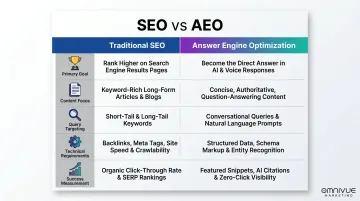
AEO does not replace SEO-it extends it. Strong fundamentals (crawlable architecture, quality content, authoritative backlinks) are still required. AEO layers on top with AI-specific formatting, E-E-A-T signals, and multi-platform brand presence that help AI systems recognize, trust, and cite your brand.
You'll also see this called GEO (Generative Engine Optimization) or AIO (AI Overviews) depending on the platform. The label varies, the underlying goal doesn't: be the source AI cites when your audience asks a question, not just a link they might click. Omnivue builds this into every SEO engagement, covering visibility across ChatGPT, Gemini, and Perplexity alongside traditional search.
Why AEO Matters for Small and Mid-Sized Businesses Right Now
The migration to AI-powered search is not a future trend-it's happening now. ChatGPT has reached over 900 million weekly active users and 50 million subscribers, while Google AI Overviews coverage grew 58% year-over-year and now approaches 50% of tracked queries. Gartner predicts traditional search engine volume will drop 25% by 2026 due to AI chatbots and virtual agents.
The Zero-Click Problem
When AI generates an answer directly, users often don't click through to websites-meaning organic traffic can decline even as brand awareness builds. AI Overviews reduce organic click-through rates for position-one content by 58%, and a randomized field experiment confirmed that AIOs reduce outbound organic clicks by 38%. For SMBs that rely on website visits for leads and sales, this represents a real and growing revenue risk.
The SMB Opportunity
AEO gives small and mid-sized businesses a direct route into AI-generated answers. AI tools do not automatically favor the largest brand or the highest-ranking domain. Well-structured, trustworthy content that directly answers a specific question can get cited ahead of a Fortune 500 competitor's vague homepage.
Why SMBs can compete:
- AI engines cite sources based on answer quality and structure, not domain size
- Google AI Overviews source approximately 18% of citations from User-Generated Content (forums, Reddit, YouTube), not just high-authority domains
- YouTube is the most-cited domain in AI Overviews, accounting for 5.6% of all AIO URLs cited-even when videos don't rank in the top 100 organic results
- 62% to 88% of AI citations come from outside the top 10 organic results
That last point matters most for SMBs-and it's exactly what makes AEO worth pursuing now, not later.
Case in point: Omnivue Marketing's work with NAM Rentals, a construction equipment rental company, shows what's possible. Starting with zero AI visibility, NAM Rentals now appears in Google AI Overviews for high-intent queries like "affordable scissor lift rental Toronto" and "best scissor lift rental Toronto," cited alongside major competitors including United Rentals and DOZR. Within six months, the company had 30+ AI mentions across ChatGPT, Gemini, and Google AI Overviews.
How to Optimize Your Content for AI Search Engines
Targeting the Right Questions
AEO starts with one shift: stop planning content around keywords and start planning it around the actual questions your audience types into ChatGPT or Perplexity.
Where to find real questions your audience asks:
- Customer support records and help desk tickets
- Sales call notes and common objections
- Reddit threads in your industry subreddit
- Google's "People Also Ask" boxes
- Conversational AI tools themselves (prompt ChatGPT with a broad topic and ask "What questions do people have about [topic]?")
The difference matters. A keyword query like "best accounting software" pulls up a list. A conversational prompt like "What accounting software should I use if I'm a freelancer in Canada?" triggers a direct recommendation. Build content that answers the specific, long-tail version, that's what gets cited.
Once you've identified the right questions, how you structure the answers determines whether AI systems can actually extract and surface them.
Structuring Content for AI Readability
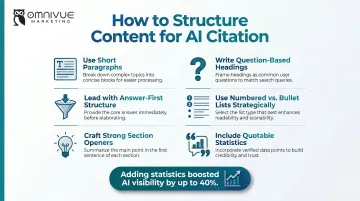
AI systems extract information more easily when content follows clear, logical formatting patterns. These tactics benefit both AI and human readers.
Core formatting tactics:
- Keep paragraphs to 2-3 sentences, one idea per block
- Write headings that mirror real search questions, not internal labels
- Answer first, then explain, never bury the conclusion after a preamble
- Use numbered lists for step-by-step processes, bullets for features or options
- Open each section with the key takeaway, not a setup
Make content quotable: Replace vague claims with precise, citable statements. Instead of "email marketing can be effective," write "email marketing generates $36 for every dollar spent." Research from Princeton shows that adding statistics and quotations boosted visibility in generative engines by up to 40%.
Building E-E-A-T Signals Into Your Content
AI systems prefer sources that demonstrate Experience, Expertise, Authoritativeness, and Trust (E-E-A-T). Google's automated systems prioritize helpful, reliable information created to benefit people, and other AI platforms follow similar principles.
Practical E-E-A-T tactics for SMBs:
- Add real author bios: Include credentials, years of experience, and relevant qualifications
- Cite your own results: Reference client case studies, internal data, or firsthand outcomes
- Use firsthand language: Write "in our experience" or "we've found" to signal direct knowledge
- Keep information current: Update statistics and examples regularly; include publication or update dates
- Link to credible sources: Reference trusted industry publications, research studies, and authoritative organizations
AI tools draw from sources the wider web already trusts. That means E-E-A-T isn't built only on your site, it's built through mentions, links, and citations across the web. Guest contributions, industry press, and even being quoted in other credible content all reinforce your authority in AI training data.
Technical and Off-Site AEO Tactics That Build Lasting Visibility
Technical Foundations
AI crawlers need to access and parse your content efficiently. Technical requirements that enable AI visibility include:
- Render pages server-side, client-side JavaScript alone can block AI bots from parsing your content
- Keep load times fast, slow pages get crawled less often and less completely
- Use HTTPS, secure sites signal trustworthiness to both users and AI systems
- Audit your robots.txt, confirm AI bots (OAI-SearchBot, GPTBot, PerplexityBot, GoogleBot) are allowed to crawl your site
Schema markup is a structured way to tell AI systems what type of content a page contains. Common schema types for AEO include:
| Schema Type | Purpose | Best For |
|---|---|---|
| FAQPage | Marks up frequently asked questions | Q&A content, support pages |
| HowTo | Explains step-by-step processes | Tutorials, guides, instructions |
| Article | Standard article properties | Blog posts, news, thought leadership |
| Speakable | Indicates content suitable for text-to-speech | News articles, audio-friendly content |
WordPress and Shopify both support schema through plugins, so implementation doesn't require coding knowledge. If you're working with an agency, schema readiness and crawlable architecture should be standard deliverables, not add-ons.
Reality check on schema: While schema helps machines understand content, a study tracking 1,885 pages found that adding JSON-LD schema produced no major uplift in AI citations. Schema is a foundation. Content quality and brand authority drive actual AI citation rates.
Building Mentions and Co-Citations
Technical work gets you crawlable. Off-site signals get you cited. AI systems build brand understanding not just from your website but from how your brand appears across the web. Co-citations occur when your brand is consistently mentioned alongside competitors or industry terms on third-party sites, helping AI tools recognize your brand as belonging to a specific category.
Actionable co-citation tactics:
- Publish thought leadership in industry publications and niche blogs to establish category authority
- Get included in "best of" lists, software comparisons, and buying guides where your category is actively researched
- Answer questions on Reddit, LinkedIn, Quora, and industry forums, AI tools actively index these platforms
- Keep listings accurate and complete across Google Business Profile, Yelp, and industry-specific directories
Multi-platform visibility matters: AI tools actively pull from YouTube, Reddit, forums, podcasts, and social platforms-not just traditional web pages. For SMBs, this doesn't mean being everywhere at once. Identify one or two platforms where your audience already asks questions and build a consistent presence there.
Example for local businesses:
A security company like Secure Shield Security can use:
- Answer Q&A questions, post updates, and gather reviews on Google Business Profile
- Create short Q&A videos on YouTube addressing questions like "How do I choose a commercial security system?"
- Participate in local or industry subreddits offering genuine advice, without overt self-promotion
Omnivue's authority-building service takes this approach, combining digital PR, link acquisition, and consistent brand entity signals across platforms to make it clear to AI tools which category your brand belongs in.
Auditing Your Current AI Visibility
Before investing in tracking tools, conduct a manual audit to understand your baseline:
- Identify target questions: Write 10-15 questions your ideal customer would ask
- Prompt AI tools: Enter each question into ChatGPT, Perplexity, Google AI Mode, and Gemini
- Record citations: Note which brands and sources get cited in each response
- Identify gaps: Where does your brand appear? Where is it missing? Which competitors consistently show up?
- Guide priorities: Use findings to prioritize content creation and outreach
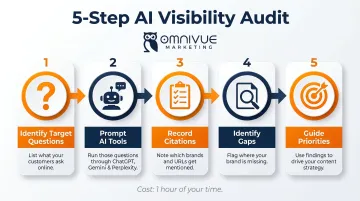
The audit costs nothing but an hour of your time, and it tells you exactly where to focus first.
How to Track and Measure Your AEO Performance
Direct attribution for AI search is currently limited. You'll need a combination of purpose-built tools and proxy metrics to measure success accurately.
What to Track
Core AEO metrics:
- AI citation frequency: How often your brand appears in AI-generated answers, and for which target questions
- AI Overviews appearances: Visibility in Google's AI-generated summaries (tracked via manual audits, as Google Search Console folds this data into general "Web" traffic without a dedicated filter)
- Referral traffic from AI platforms: Monitor analytics for referral sources from ChatGPT, Perplexity, and similar tools
- Brand mention changes: Whether mentions are growing, shrinking, or shifting across AI platforms over time
Purpose-Built AI Visibility Tools
For teams that want to automate tracking at scale, several dedicated AI visibility platforms exist:
- Semrush AI Visibility Toolkit: Tracks ChatGPT, Google AI Mode, and Gemini; calculates AI Visibility Score and analyzes Share of Voice and sentiment
- Profound: Uses real user conversations to rank brands based on citation frequency in ChatGPT, Claude, Gemini, Perplexity, and AI Overviews
- AthenaHQ: Provides cross-platform AI visibility tracking with automated content optimization recommendations for ChatGPT, Perplexity, Gemini, AI Overviews, and Claude
For clients who want this all in one place, Omnivue Marketing's OmniTrack Analytics Platform handles it natively, monitoring AI Overview appearances, brand mentions across ChatGPT, Gemini, and Google AI Overviews, and pages cited by LLMs, with cross-platform attribution that connects AEO visibility directly to business outcomes.
Connecting AEO to Business Outcomes
AEO often produces zero-click visibility, brand exposure without a website visit. That means traffic alone won't tell the full story, and success metrics need to expand accordingly.
Proxy indicators of AEO success:
- Branded search volume growth: People searching specifically for your brand name after encountering it in an AI answer
- Direct traffic trends: Users typing your URL directly, often a signal they discovered you through an AI platform
- Lead source attribution shifts: Leads reporting they found you through ChatGPT or Perplexity, tracked through intake forms or sales conversations
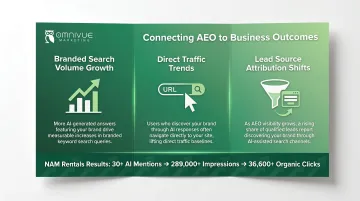
NAM Rentals demonstrated this pattern, moving from zero AI visibility to 30+ AI mentions across platforms, 289,000+ total impressions, and 36,600+ organic clicks, showing how AI citation visibility correlates with overall organic growth.
Frequently Asked Questions
What is answer engine optimization?
AEO is the practice of structuring and optimizing content so AI-powered tools like ChatGPT, Google AI Overviews, and Perplexity cite and surface your brand in their generated answers-going beyond traditional search rankings to achieve direct visibility inside AI responses.
How to optimize content for AI search engines?
Start with clear question-and-answer formatted content and structured headings that deliver direct answers. Then layer in:
- Schema markup (FAQ, HowTo, Article)
- Citable statistics and expert quotes
- Brand mentions across third-party platforms to signal authority to AI systems
What are the best options for answer engine optimization in AI?
Strong AEO starts with SEO fundamentals-quality content, a crawlable site, and backlinks. On top of that, layer AI-specific tactics: FAQ and speakable schema, conversational content targeting, multi-platform brand presence, and consistent E-E-A-T signals across owned and third-party content.
Which AI optimization is best for product visibility?
Ensure product and category pages directly answer specific buyer questions (such as "best [product type] for [use case]") and use structured data like Product and Review schema. Getting consistently mentioned in comparison content and industry roundups also significantly improves how AI tools surface your products.
What is the 80/20 rule in SEO?
In SEO, the 80/20 principle suggests roughly 20% of your optimization efforts-targeting the right intent, earning authoritative mentions, maintaining technical health-drive 80% of your visibility results. The same principle applies to AEO: answering a focused set of high-intent questions your audience actually asks will outperform trying to cover every topic broadly.