This guide covers platform selection, keyword strategy, compliant ad creative, landing page trust signals, and revenue-tied attribution-all updated for 2026's AI-driven ad ecosystem where broader match types and automated bidding mean platforms make more targeting decisions autonomously.
TLDR
- Financial PPC demands unique tactics due to strict ad policies, high CPCs ($3.46 average), and multi-month buyer journeys
- Google Ads captures high-intent demand; Microsoft Ads and LinkedIn serve valuable supporting roles for B2B and older demographics
- Keyword strategy balances commercial intent with aggressive negative keyword lists to prevent budget waste
- Compliance failures in ad copy cause account suspensions, not just disapprovals-certifications and platform checks are non-negotiable
- Revenue-tied attribution-not lead volume-is what separates scalable financial PPC programs from expensive ones
Why Financial Services PPC Is Its Own Beast in 2026
Three forces make financial PPC uniquely difficult compared to other industries:
1. Regulatory scrutiny crushes non-compliant advertisers
Google's financial services ad policy requires certification, mandatory fee disclosures, and transparent terms. Advertisers must complete location-specific verification and include representative APR examples for loans. In Canada specifically, the Financial Consumer Agency of Canada requires that any ad mentioning an interest rate or payment amount disclose the APR and loan term "at least as prominently as the prescribed representation."
Non-compliance carries real consequences. Google issued 12.7 million account suspensions across all categories in 2023, with financial services violations among the leading causes.
2. Keyword competition drives costs to unsustainable levels
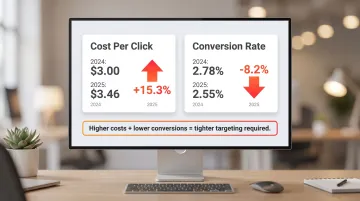
Financial keywords rank among the most expensive in digital advertising. The average CPC for Finance & Insurance hit $3.46 in 2025, a 15.3% increase year-over-year. Mortgage, insurance, and investment-related terms regularly exceed $5–$8 per click, with some wealth management keywords topping $10.
Conversion rates are simultaneously declining, down 8.2% from 2024. Brands now need tighter targeting and stronger conversion infrastructure just to hold previous performance levels.
3. Trust deficit makes conversion harder post-click
Consumers are more skeptical of financial ads than nearly any other category. Even when someone clicks, converting them requires substantial trust signals, compliance-heavy landing pages, and often multiple touchpoints. STRATMOR data indicates the average mortgage refinance takes 60 days to close, with many institutions experiencing 90-110 day cycles. This extended timeline means last-click attribution systematically under-credits upper-funnel activities.
2026's AI-Driven Ad Landscape Adds New Complexity
Broader match types and automated bidding mean platforms make more targeting decisions autonomously. For financial brands, this creates risk of irrelevant traffic or non-compliant audience signals. Google and Microsoft have responded by introducing new Performance Max controls in 2026, including campaign-level negative keywords, search term visibility, and first-party audience exclusions. Without tight human oversight of campaign inputs, those new controls don't protect you, they just create the illusion that they do.
The longer the financial decision cycle (mortgage, wealth management, insurance), the more touchpoints are involved before conversion, and the less reliable last-click attribution becomes. That's why this playbook addresses the full funnel, from ad copy compliance to post-click conversion infrastructure.
Choosing the Right PPC Platforms for Financial Brands
Google Ads
Google Search campaigns form the foundation for financial PPC due to high purchase intent at the keyword level. Search campaigns for product-specific terms-such as "best HELOC rates," "fee-only financial advisor Toronto," or "low-rate personal loan Canada"-consistently outperform broad awareness formats for most financial brands.
Performance Max requires caution in financial services. While automation is useful, it demands tight asset control and close monitoring for compliance. The 2026 updates to Performance Max now allow campaign-level negative keywords, search term reporting, and first-party audience exclusions-giving advertisers more control over where automated campaigns appear. Financial brands should use these tools to prevent ads from surfacing on irrelevant or non-compliant queries.
Omnivue, as a Google Partner, helps financial brands structure campaigns correctly from the start, ensuring compliance protocols are built into campaign architecture rather than added as an afterthought.
Microsoft (Bing) Ads
Microsoft Ads is underused but valuable for financial services. The platform offers:
- 30-60% lower CPCs than Google due to less advertiser competition
- Built-in LinkedIn audience data for professional targeting-useful for B2B financial services, commercial lending, and wealth management
- Older, higher-income audience: Microsoft's search users skew toward demographics that match financial products like retirement planning and estate services
Microsoft introduced self-serve negative keyword support for Performance Max in March 2026, allowing up to 5,000 negative keywords per list at campaign or account level. This update makes the platform even more viable for regulated industries.
Think of Microsoft Ads as a cost-efficient secondary channel that extends reach without duplicating Google spend. Where search captures intent, paid social widens the funnel for the right audiences.
Paid Social and Programmatic
LinkedIn Ads are the strongest paid social option for B2B financial services. Target by company size, job title, and industry to reach decision-makers for commercial lending, corporate benefits, or wealth management services. However, CPCs are premium: Financial Services CPCs on LinkedIn average $6.84, and Cost Per Lead averages $148. Using native LinkedIn Lead Gen Forms can reduce CPL by 25-35% compared to external landing pages.
For Meta and programmatic, the use cases are narrower:
- Meta: Best for remarketing to warm audiences during long consideration cycles-not cold acquisition
- Programmatic: Keeps brands visible across multi-month decision journeys where repeat exposure builds trust
Both channels require strict creative compliance and deliver weaker purchase-intent signals than search.
Keyword Strategy: Win High-Intent Traffic Without Burning Budget
Focus on Commercial Intent and Long-Tail Terms
The keyword intent spectrum runs from informational ("how does a HELOC work") to commercial ("best HELOC rates Canada") to transactional ("apply for HELOC online"). Financial brands should prioritize commercial and transactional terms in paid search, where buyer signals are clear. Redirect informational queries to SEO or content instead, paying $3.46+ per click for "how does insurance work" burns budget on users who are months away from a decision.
Long-tail keywords drive higher conversion at lower cost. Three-to-five word phrases that are geographically specific, service-specific, or audience-specific (e.g., "financial advisor for small business owners Toronto," "low-rate personal loan Canada") consistently outperform broad head terms. Research shows that long-tail keywords convert at 2.5x higher rates than head terms, and four-word keywords convert at 1.61% versus 0.17% for one-word terms.
Branded vs. non-branded keyword split matters:
- Branded campaigns protect existing equity and convert at high rates, but they capture demand that already exists, not new customers
- Non-branded campaigns drive net-new acquisition and require tighter bid controls, Quality Score optimization, and strong landing page relevance
Build a Robust Negative Keyword List
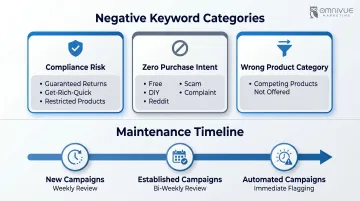
In financial services, negative keywords function as a budget protection mechanism. With AI and broad match expanding reach, they prevent ads from showing on searches like "free financial advice," "financial scams," or terms related to restricted products.
Practical framework for negative keyword categories:
- Guaranteed returns, get-rich-quick phrasing, and restricted product language (compliance risk)
- DIY, free, Reddit, forum, scam, complaint, lawsuit (zero purchase intent)
- Competing product categories you don't offer, if you sell mortgages, exclude "auto loan," "car financing," etc.
Once your categories are defined, maintain them on a consistent schedule to stay ahead of drift.
Maintenance schedule:
- New campaigns: review search term reports weekly
- Established campaigns: bi-weekly reviews are sufficient
- Automated campaigns: flag any unexpected query categories immediately
With Google's 2026 updates adding search term visibility to Performance Max, you can now see which queries trigger PMax ads and apply negative keywords at the campaign level. Use that visibility to build a PMax-specific negative list early, before wasted spend accumulates across automated placements.
Writing Compliant Ad Copy and Building Trust-First Landing Pages
Ad Copy That Passes Compliance and Earns the Click
Google's financial advertising certification and disclosure requirements are strict and enforced at the account level:
- Ads must be factually accurate and not make unsupported performance claims
- Must include required disclosures (representative APR, regulatory body membership)
- Must comply with country-specific regulations (such as Canada's FCAC rules on APR prominence)
- Violations result in account-level suspension after accumulated strikes-a legal review before any campaign goes live is essential
Practical copywriting framework for compliant-but-compelling ads:
- Lead with a specific value proposition (not vague claims like "best rates")
- Address the searcher's exact need in the headline ("Low-Rate Personal Loans for Debt Consolidation")
- Use sitelink extensions to show trust signals (certifications, reviews, specific service pages)
- Keep CTAs clear and realistic ("Get a Free Quote," "Book a Consultation"-not "Instant Approval" or "Guaranteed Rates")
Testing strategy for financial ad copy:
Test tone (informational vs. urgency-forward), CTA phrasing, and headline specificity-but avoid testing claims that approach compliance gray areas. Small, safe variations can produce measurable lift without legal exposure.
Test example: "Compare Personal Loan Rates" vs. "Find Your Personal Loan Rate", not claims about approval speed or qualification criteria.
Landing Page Principles for Financial Services
The landing page must be a direct continuation of the ad, same offer, same tone, same product focus. Mismatched experiences kill conversion rates even when the ad copy is strong. Build dedicated landing pages per campaign or ad group rather than routing traffic to a homepage or general services page.
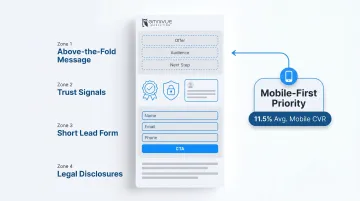
Trust architecture of a high-converting financial landing page:
- Clear above-the-fold message: what the offer is, who it's for, what happens next
- Regulatory memberships, security badges, testimonials, and a visible privacy policy link
- Short initial form, name, email, and phone only (not a full financial intake)
- Required legal disclosures present and readable, not buried in footer text
- Mobile-first layout: financial services mobile traffic converts 27.8% better than desktop, with an average mobile CVR of 11.5%
Landing page conversion benchmarks by financial subcategory:
- Insurance: 18.2% median conversion rate
- Credit and Lending: 8.8%
- Overall Finance & Insurance: 8.3%
- Investing: 3.9%
Pages converting below these numbers typically have a post-click problem, not an ad problem. Trust badges can increase conversions by 16% and revenue by 21.3%, but limit them to 2-3 per page. Too many badges creates visual noise that undermines the credibility you're trying to build.
Tracking What Actually Drives Revenue
Financial services PPC measurement must go beyond lead volume. A high number of form fills means nothing if those leads don't qualify, convert to funded accounts, or generate revenue.
Lead-to-revenue mapping-connecting ad platform data to CRM outcomes like loan approvals, issued policies, or opened accounts-is what separates scalable financial PPC programs from expensive ones.
The Attribution Challenge Specific to Financial Services
Because purchase decisions span weeks or months across multiple touchpoints (search, remarketing, email, referral), last-click attribution systematically under-credits upper-funnel and assist touchpoints. Research shows last-click models fail in financial services where journeys often exceed 90 days.
Data-driven attribution or custom attribution models provide more accurate alternatives. Google's Enhanced Conversions for Leads (ECfL) uses hashed first-party customer data collected on lead forms to match back to signed-in Google accounts, providing greater durability and cross-device tracking. Advertisers using first-party data with ECfL saw a median 10% increase in conversions compared to standard offline imports.
Practical Infrastructure for Better Financial PPC Measurement
Set up these components:
- Google Ads conversion tracking connected to CRM milestones, not just form submissions
- Imported offline conversions for phone-qualified leads or funded applications
- Call tracking for financial brands where phone inquiries are a primary lead type
- Enhanced Conversions for Leads configured with hashed email data from lead forms
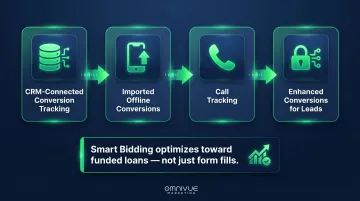
This infrastructure allows smart bidding algorithms to optimize toward quality leads rather than volume. Without it, automated bidding optimizes for form fills-not funded loans or opened accounts.
With the right infrastructure in place, attribution modeling becomes far more reliable. Omnivue's proprietary OmniTrack Analytics Platform connects campaign data to CRM milestones and closed revenue, so financial advertisers can trace which campaigns actually close business, not just which ones generate clicks.
Using Measurement Data to Drive Ongoing Optimization
Once revenue-tied conversion data flows, campaigns can be evaluated on cost-per-qualified-lead and ROAS rather than cost-per-click. Performance reviews should follow this cadence:
- Weekly reviews for active optimization: bid adjustments, negative keyword additions, search term audits
- Monthly reviews for strategic evaluation: connecting campaign-level data to business outcomes, identifying which campaigns need structural change vs. minor adjustments
Signals that indicate a campaign needs structural change (not just bid tweaks):
- Qualified lead rate below 20% of total leads
- Cost per qualified lead exceeds target by 50%+
- Conversion lag time exceeds 120 days consistently
- Search term reports showing high irrelevant query volume
Frequently Asked Questions
What is PPC in finance?
PPC (pay-per-click) in finance refers to paid digital advertising campaigns-typically on search engines and social platforms-where financial brands pay each time a potential customer clicks their ad. The goal is generating qualified leads, applications, or consultations for financial products and services.
How much does PPC cost for financial services?
Financial services keywords are among the most expensive in digital advertising due to high competition. The average CPC for Finance & Insurance is $3.46 on Google Ads, with mortgage, insurance, and investment keywords often exceeding $5-$8 per click. LinkedIn B2B financial services CPCs average $6.84. Costs vary significantly by keyword specificity, targeting, and Quality Score.
What compliance rules apply to financial services PPC ads?
Google requires financial advertisers to complete platform certifications, include required disclosures (representative APR, fees, regulatory body membership), avoid misleading claims, and comply with country-specific regulations like Canada's FCAC rules. Violations can result in ad disapprovals or account suspension-legal review of ad copy and landing pages before launch is non-negotiable.
How long does it take for financial PPC campaigns to deliver results?
PPC generates traffic within days, but financial services campaigns need 60-90 days to optimize fully. Smart Bidding algorithms require conversion data to learn, and financial buyer journeys can span weeks before a lead converts. Qualified lead volume and cost efficiency improve steadily over the first quarter.
Should financial brands use Google Ads or LinkedIn Ads?
Google Ads is better for capturing active purchase intent-people searching for financial products now. LinkedIn Ads are stronger for B2B financial services targeting professionals by job title, industry, or company size. Most financial brands benefit from using both in complementary roles: Google for demand capture, LinkedIn for B2B lead generation and remarketing.
What is a good conversion rate for financial services PPC?
Conversion rates vary by product type. Finance & Insurance averages 2.55% on Google Ads search campaigns, but landing page data shows Insurance at 18.2%, Credit/Lending at 8.8%, and Investing at 3.9%. Lead quality matters more than raw volume-a handful of qualified applicants outperforms a flood of unvetted form fills.