The choice matters more than most small business owners realize. It affects how quickly you see results, how much you pay per lead over time, and critically — whether your visibility survives the moment you reduce your marketing budget.
This guide cuts through the noise. We'll break down exactly how SEO and PPC work, where each one creates real value, and how to decide which deserves your budget right now.
TL;DR
- SEO earns organic rankings through content, technical optimization, and authority — no per-click cost, but results typically take 3–6 months minimum
- PPC places your ads immediately on Google — traffic starts fast but stops when your budget runs out
- Core differences come down to speed, cost structure, targeting control, and long-term sustainability
- Neither is universally better — your business stage, budget, and timeline should drive the decision
- Most growing businesses benefit from running both in a coordinated way once demand is validated
SEO vs. PPC: Quick Comparison
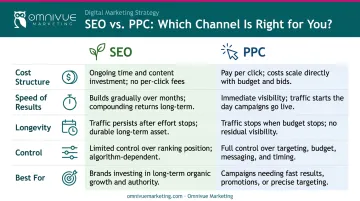
Here's how the two channels stack up across the dimensions that matter most to growing businesses:
| Dimension | SEO | PPC |
|---|---|---|
| Cost Structure | Investment in content, technical optimization, link building — no per-click fee | Ongoing media spend — you pay each time someone clicks |
| Speed of Results | Rankings build over months | Campaigns go live within days |
| Longevity | Rankings persist even if you pause spending | Traffic stops immediately when budget is paused |
| Control | Algorithm-dependent; builds gradually through quality signals | Granular control over keywords, audience, location, schedule, bids |
| Best For | Long-term brand presence, lower acquisition costs over time | Immediate demand capture, testing, seasonal promotions |
What Is SEO?
SEO (Search Engine Optimization) is the practice of improving a website's content, structure, and authority so it ranks higher in organic — meaning unpaid — search results on Google and other search engines.
The Three Core Pillars
Every effective SEO strategy rests on three areas:
- On-page optimization — content quality, keyword relevance, meta tags, and how well a page directly answers a search query
- Technical SEO — site speed, crawlability, mobile performance, and structured data that helps Google understand your site
- Off-page SEO — backlinks and domain authority signals from other websites that tell Google your content is trustworthy
All three work together. A technically perfect site with thin content won't rank. Great content on a slow, poorly structured site won't either.
The Compounding Advantage
SEO rankings compound over time — and that compounding is what makes the channel worth the patience. According to Ahrefs, 72.9% of pages in Google's top 10 are more than three years old. Once a page earns a strong ranking, it continues attracting traffic without additional spend — and the domain authority built over time makes future content easier to rank.
That said, the flip side is real. The same Ahrefs research found 96.55% of pages get no organic traffic from Google at all. SEO compounds, but only for content that actually earns rankings. Volume without strategy produces very little.
The position you rank at matters enormously. Backlinko's 2025 analysis found the #1 organic result earns a 27.6% average click-through rate — compared to a 6.66% average CTR for paid search ads. Ranking at the top of organic results is a durable, high-value traffic asset.
SEO in 2025–2026: Beyond Google
Traditional keyword ranking still matters — but SEO now extends further. McKinsey's 2025 research found roughly 50% of consumers now use AI-powered search to guide buying decisions, with 44% preferring AI search as their primary insight source over traditional search engines.
Tools like ChatGPT, Gemini, and Perplexity don't just rank pages — they cite them. Content that earns authority, answers specific questions clearly, and is structured for AI retrieval appears as a cited source in AI responses.
Google has confirmed there are no separate requirements for AI Overviews or AI Mode beyond standard SEO fundamentals: crawlable, indexed, and genuinely helpful content. Answer Engine Optimization (AEO) builds on this — structuring content so it's discoverable across both traditional search and AI-powered discovery engines like ChatGPT, Gemini, and Perplexity.
Where SEO Creates the Most Value
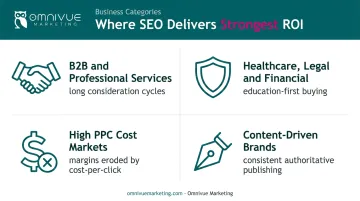
SEO delivers the strongest returns for:
- B2B and professional services with long consideration cycles (buyers research extensively before contacting anyone)
- Healthcare, legal, and financial services where trust is built through educational content before a purchase decision
- Markets with high PPC costs where paying per click erodes margins quickly
- Content-driven brands that can consistently publish useful, authoritative material
Real example: Secure Shield Security, a commercial security services company in Toronto, worked with Omnivue on SEO and content strategy. According to their co-founder, the SEO work "significantly boosted organic traffic, delivering real results we can measure" — the kind of compounding inbound visibility that doesn't disappear with a budget cut.
What Is PPC (Pay-Per-Click Advertising)?
PPC is a paid advertising model where businesses bid on keywords and pay only when a user clicks their ad. Google Ads is the dominant platform, placing text ads at the top of search results for relevant queries.
How the Auction Works
Each time someone searches on Google, an ad auction runs in milliseconds. Your position isn't determined by budget alone. Google factors in ad relevance and landing page quality alongside your bid, which means a well-structured campaign from a smaller advertiser can outrank a bigger competitor with a poor-quality ad.
Most Google Ads campaigns go live within one business day of review, making it the fastest way for any business to gain search visibility.
Core PPC Ad Formats
| Format | Best For |
|---|---|
| Search Ads | Capturing high-intent keyword searches ("HVAC repair Toronto") |
| Display Ads | Brand awareness across websites and apps |
| Shopping Ads | E-commerce product listings with images and pricing |
| YouTube Ads | Video-based awareness and retargeting |
For most small businesses, Search Ads are the primary format — they intercept buyers who are actively searching for what you sell.
What PPC Costs in Practice
WordStream's 2025 benchmark data based on 16,446 U.S. search campaigns shows:
- All-industry average CPC: $5.26
- All-industry average cost per lead: $70.11
- Restaurants and Food CPL: $30.27
- Business Services CPL: $103.54
Costs vary significantly by industry. A food and beverage business operates on very different economics than a B2B services firm, so benchmark your category before setting budget expectations.
Where PPC Creates the Most Value
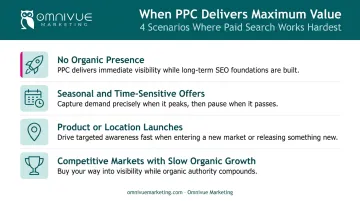
PPC works best for:
- Businesses with no organic presence that need traffic from day one
- Seasonal promotions or time-sensitive offers where speed matters
- Product or location launches where demand already exists
- Competitive markets where organic rankings take years to build
Real example: A food and beverage brand launching a new Toronto location can use Google Search Ads to capture "best burgers near [neighbourhood]" searches from day one — generating traffic and foot traffic while their organic SEO presence is still being built.
SEO vs. PPC: Which Is Right for Your Business?
The right answer depends on where your business is right now, not which channel is theoretically superior.
Choose PPC When:
- You're a new business with no organic search presence
- You need to validate whether demand exists for your offer before committing to long-term content investment
- You're running a time-sensitive promotion or launch
- Your organic competitors are too established to displace quickly
- You can afford ongoing media spend and want measurable, immediate results
Choose SEO When:
- You're building for 12+ month visibility that doesn't evaporate if you reduce spending
- Your industry carries high PPC costs that compress margins — Business Services averages $103.54 per lead
- You're creating educational or informational content that nurtures buyers before they're ready to purchase
- You want to reduce long-term customer acquisition costs as organic rankings build momentum over time
The Budget Reality
PPC requires continuous spend to maintain traffic. Pause the budget, and visibility stops immediately. SEO demands patience upfront, but well-established organic rankings keep generating leads at a declining cost-per-acquisition over time.
For businesses that want both channels working in sync, Omnivue Marketing (a Google Partner agency) coordinates SEO and PPC as a single strategy — so insights from paid campaigns directly sharpen organic targeting, and vice versa.
When SEO and PPC Work Better Together
The strongest case for combining both channels isn't theoretical — it's supported by how search results actually work.
Incremental Click Coverage
Google's foundational research on ad pause studies found that 89% of search ad clicks were not replaced by organic clicks when ads were paused. Appearing in both paid and organic results simultaneously captures clicks that neither channel alone would secure — and dual presence on the same results page reinforces brand credibility.
The Data Feedback Loop
This is where the real strategic advantage lives:
- PPC → SEO: Google Ads search terms reports show exactly which keywords triggered clicks and which converted. That's actual buyer intent data — high-converting PPC terms then become the foundation for SEO content priorities, replacing guesswork with evidence.
- SEO → PPC: High-performing organic pages reveal which topics resonate with your audience. Running paid spend against those proven topics means you're amplifying what already works, not testing blind.
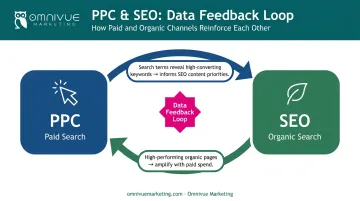
The feedback loop only works when both channels share data — which requires visibility across platforms simultaneously.
OmniTrack: Attribution Across Both Channels
When SEO and PPC data live in separate silos, you're making budget allocation decisions blind. Omnivue's OmniTrack Analytics Platform brings cross-platform attribution into a single view, connecting organic and paid touchpoints so you can see what actually drove a conversion.
Most small businesses can't tell whether a converted lead first found them through organic search three weeks ago and then clicked a retargeting ad, or the reverse. OmniTrack resolves that ambiguity, giving growing businesses the same allocation clarity that enterprise teams build entire analytics departments to achieve.
Conclusion
The SEO vs. PPC decision isn't about which channel wins — it's about which one fits where your business actually is right now. The right choice comes down to your stage, timeline, and budget:
- Use PPC when speed and demand validation matter most
- Use SEO when you're building for sustainable, compounding visibility
- Use both when budget supports it — and you have the analytics infrastructure to make coordinated decisions
The businesses that grow most effectively aren't choosing one channel over the other. PPC captures immediate demand and generates performance data. SEO builds durable visibility over time. And the data from both, tracked together, makes each channel more precise.
Getting the allocation right from the start reduces wasted spend. Getting both channels working in sync is how search stops being a cost center and starts compounding returns.
Frequently Asked Questions
What is the difference between SEO and PPC?
SEO earns organic (unpaid) rankings through content quality, technical optimization, and authority building — it takes time but creates lasting visibility. PPC involves paying for ad placement on Google, delivering immediate traffic that stops when your budget does. Both appear on the same search results page but operate through entirely different mechanisms.
Can you do SEO on Google Ads?
Google Ads does not directly improve your organic SEO rankings — Google keeps paid and organic results separate. However, running Google Ads can indirectly support SEO by revealing high-converting keywords and testing which messaging resonates before investing in long-term content optimization.
Is SEO dead or evolving in 2025–2026?
SEO is very much alive but expanding. Traditional Google rankings still matter, but SEO now also means getting cited in AI-powered tools like ChatGPT, Gemini, and Perplexity. Content authority and direct question-answering have become more valuable, not less, as these platforms grow.
What is the 80/20 rule for SEO?
Organic traffic concentrates heavily on a small number of pages and top-ranking results. Ahrefs data shows 96.55% of pages receive zero organic traffic from Google. Prioritizing your highest-potential content and keyword clusters drives outsized results compared to spreading effort evenly.
How long does SEO take to show results?
Most businesses see measurable ranking improvements within 3–6 months of consistent SEO work. Competitive industries or new websites with limited authority often take 6–12 months.
Should a small business start with SEO or PPC?
Most small businesses benefit from starting with PPC to generate immediate traffic and validate which keywords and offers actually convert, then layering in SEO for long-term visibility. If budget is tight, starting with local SEO — Google Business Profile optimization and targeted location-based content — can provide cost-effective early traction.