This guide gives you the roadmap to avoid that outcome. You'll learn how PPC auctions actually work, why small businesses benefit from paid search, how to build a campaign that converts, what realistic budgets look like across industries, and when professional management pays for itself. If you've ever wondered whether $300 a month is enough to compete, or whether you should just hire an agency from day one, this guide answers those questions.
TLDR
- PPC (pay-per-click) lets you pay only when someone clicks your ad, putting you at the top of search results instantly
- Budget control is built-in, set daily limits and scale only when results justify it
- Campaigns need continuous optimization; set-and-forget wastes budget within weeks
- Results come fastest when your platform choice, keyword targeting, and landing pages are working toward the same goal
What Is PPC and How Does It Work?
PPC stands for pay-per-click advertising, an auction-based model where advertisers bid on keywords, and ads are ranked by a combination of bid amount and quality score. You don't pay to show your ad; you only pay when someone clicks it. That shifts the model entirely, instead of paying for exposure, you pay only when someone actually arrives at your site.
Every time someone searches on Google, a real-time auction determines which ads appear and in what order. Placement is determined by Ad Rank, Google's score based on your bid, ad quality, landing page relevance, auction competitiveness, search context, and expected ad extension impact.
What you actually pay per click is often less than your maximum bid. Google charges only the minimum amount required to clear Ad Rank thresholds and beat the advertiser immediately below you. This means better quality ads cost less per click, a direct cost advantage for campaigns that maintain strong relevance scores.
Main PPC ad types for small businesses:
- Search ads, text ads at the top of Google results, targeting people actively searching for what you offer
- Display ads, visual banners across partner websites, best for building awareness with cold audiences
- Remarketing ads, follow-up ads shown to past visitors as they browse elsewhere, keeping your brand in front of warm prospects
Google Ads is the dominant starting point for most small businesses, with Meta Ads (Facebook/Instagram) as the key social alternative for audience-based targeting.
Why PPC Works for Small Businesses
Immediate Visibility Without Waiting for SEO
Unlike SEO, which can take months to generate organic rankings, PPC puts your business at the top of search results from day one. Most Google ads are reviewed within one business day and start running as soon as they're eligible.
This speed matters for new businesses launching their first website, seasonal promotions that can't wait six months for organic traffic, or competitive markets where you need visibility now while SEO builds in the background. Only 1.74% of newly published pages rank in Google's top 10 within a year, making paid search the only viable short-term traffic strategy for most small businesses.
Precise Targeting That Matches Budget Reality
Small businesses can target with precision across multiple dimensions:
- Location, down to a specific radius, critical for local service businesses
- Device type, desktop, mobile, or tablet
- Time of day, show ads only during business hours or peak demand windows
- Demographics and search intent, reach people actively looking to buy
This precision means every dollar targets people most likely to convert rather than broad audiences.
A Toronto-based HVAC company can show ads only to homeowners within 25 kilometers searching for "furnace repair" between 7 AM and 10 PM. A security company in Dubai can target businesses in specific districts searching for "commercial security installation." This targeting efficiency is why PPC works for businesses with limited budgets, you're not paying for wasted reach.
Budget Control You Actually Control
You set daily and campaign-level budget caps, and you only pay per click. If your daily budget is $50, Google stops showing your ads once that spend is reached. No surprise bills.
Small businesses can start modest (typically $1,000 to $2,500 monthly for search campaigns), test performance across 30 to 90 days, and scale what works without locking into fixed annual spends. If a campaign isn't delivering ROI, pause it. If it's profitable, increase the budget. This flexibility doesn't exist with traditional advertising contracts.
Measurable Results in Real Time
Click-through rate (CTR), conversion rate, cost-per-click (CPC), and return on ad spend (ROAS) are trackable in real time through your Google Ads dashboard. Contrast this with radio or print advertising, where you're guessing whether anyone took action.
This data tells you exactly what's working and where to optimize. If your ad for "emergency plumbing" converts at 8% but your ad for "plumbing services" converts at 2%, shift budget to the winner. That kind of decision used to require months of guesswork, PPC makes it a two-week test.
The "Set and Forget" Trap, Why Active Management Matters
PPC is not passive. Campaigns left unmonitored waste budget quickly through irrelevant clicks, outdated bids, or poor quality scores. A study of over 15,000 Google Ads accounts found that 29% recorded zero conversions over 90 days, often because conversion tracking was never set up. The same study found 25% of those accounts had never added a single negative keyword.
Campaigns need ongoing keyword refinement, bid adjustments, and ad copy testing to stay efficient. Plan to spend 3 to 5 hours per week on active management, or work with someone who will own that for you.
How to Build Your First PPC Campaign
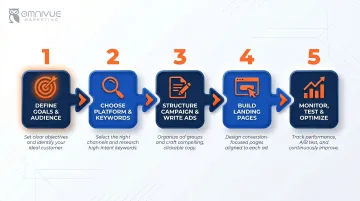
Step 1, Define Goals and Know Your Audience
Before touching any platform, identify one clear campaign objective: lead generation, online sales, phone calls, or store visits. Vague goals produce vague results.
Define the customer you're targeting: what they search for, where they are, and what pain point your ad should address. A restaurant targeting lunch traffic needs different keywords and ad copy than one targeting evening reservations.
Write this down:
- Goal: Generate 20 qualified leads per month
- Audience: Homeowners in [City] with properties over 2,000 sq ft
- Pain point: Need reliable HVAC service before winter
- Search behaviour: "furnace inspection near me," "heating system maintenance [City]"
Step 2, Choose the Right Platform and Keywords
Google Ads suits high-intent searches, people actively looking for "emergency plumber near me" or "divorce lawyer Toronto." Meta Ads suits audience-based targeting, reaching people based on interests, demographics, and behaviours even if they aren't actively searching.
Keyword selection:
Use Google Keyword Planner to find high-intent, lower-competition keywords. Prioritize long-tail keywords, specific, multi-word phrases like "furnace repair North York" instead of broad terms like "HVAC." Long-tail keywords convert 2.5x higher than head terms and cost less per click because fewer advertisers compete for them.
For service businesses, include geographic modifiers: "plumber [neighborhood]," "lawyer near [landmark]," "restaurant [street name]." These local terms capture buyers ready to act now.
Add negative keywords from day one:
Negative keywords exclude specific search terms from your campaigns, ensuring your ads only show for relevant queries. If you sell premium security systems, add "free," "cheap," "DIY," and "discount" as negatives. If you're a divorce lawyer, exclude "paralegal" and "free consultation." You can create negative keyword lists containing up to 5,000 terms and apply them across multiple campaigns.
Step 3, Structure Your Campaign and Write Ads That Convert
Campaign structure:
Group tightly themed keywords into focused ad groups (10 to 20 keywords maximum per ad group). Each ad group should focus on one specific intent. Don't mix "plumbing repair" keywords with "new bathroom installation" keywords, they serve different customer needs and require different ads.
Write compelling ad copy:
- Headline 1: Address user intent directly ("Emergency Furnace Repair in Toronto")
- Headline 2: Include a benefit or differentiator ("Licensed Technicians • Same-Day Service")
- Description: Solve the pain point and include a clear CTA ("Frozen furnace? Our licensed technicians arrive within 2 hours. Call now for fast, reliable repair.")
Google's Responsive Search Ads (RSAs) let you provide up to 15 headlines (30 characters each) and 4 descriptions (90 characters each). Google tests combinations to find what performs best.
Use ad extensions:
Sitelink assets drive 15% more conversions on average when ad strength improves from "Poor" to "Excellent." Add location extensions (show your address), call extensions (clickable phone number), and sitelinks (links to specific pages like "Book Appointment" or "View Pricing").
Step 4, Build Landing Pages That Complete the Job
The landing page is where clicks become customers. A weak landing page wastes every dollar spent on the click. A one-second improvement in page load speed can decrease bounce rates by 14 percentage points and increase conversions by 13%.
Landing page essentials:
- Headline matches the ad promise, if your ad says "Same-Day Furnace Repair," your landing page headline should reinforce that, not pivot to "Full-Service HVAC Company"
- Single clear CTA, one primary action (call, book, get quote), not five competing buttons
- Fast load time, optimize images, minimize scripts, use a CDN
- Mobile-optimized design, mobile devices account for 61.9% to 63% of all Google ad clicks
- Trust signals, customer reviews, certifications, years in business, service guarantees
- Ad-to-page alignment, the closer your landing page matches your ad copy, the higher your Quality Score and the lower your cost per click
Step 5, Monitor, Test, and Optimize Continuously
What ongoing management looks like:
- Check search term reports weekly to identify irrelevant queries draining budget; add them as negative keywords
- Test two versions of ad copy at a time (A/B testing) to find which headlines and descriptions drive more conversions
- Adjust bids based on device, location, and time-of-day performance, if mobile converts at half the rate of desktop, lower mobile bids by 30% to 40%
- Pause underperformers, if a keyword has 100 clicks and zero conversions, kill it
- Monitor Quality Score components, expected CTR, ad relevance, and landing page experience
Campaigns typically need 30 to 90 days of data before performance stabilizes into reliable, consistent results. Don't judge a campaign after one week.
How Much Does PPC Cost for Small Businesses?
What You Pay For: Ad Spend vs. Management Fees
PPC costs have two components:
- Ad spend, what you pay Google or Meta per click
- Management fees, what you pay an agency or tool to manage campaigns
These are separate. If you spend $2,000 on ads and pay an agency $400 to manage them, your total monthly cost is $2,400.
Typical management fee structures:
| Pricing Model | Range | Best For |
|---|---|---|
| Flat monthly retainer | $500 to $2,500+ | Small businesses with stable budgets |
| Percentage of ad spend | 10% to 20% | Growing accounts where effort scales with spend |
What Drives Cost-Per-Click
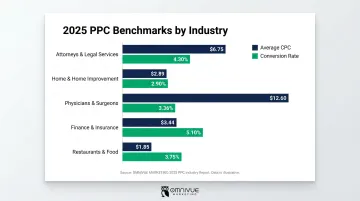
CPC varies widely by industry. Legal and home services face the highest CPCs due to high customer lifetime values.
2025 CPC benchmarks by industry:
| Industry | Average CPC | Conversion Rate |
|---|---|---|
| Attorneys & Legal Services | $8.58 | 5.09% |
| Home & Home Improvement | $7.85 | 7.33% |
| Physicians & Surgeons | $5.00 | 11.62% |
| Finance & Insurance | $3.46 | 2.55% |
| Restaurants & Food | $2.05 | 7.09% |
Factors influencing CPC:
- Industry competitiveness, insurance and legal keywords command the highest CPCs
- Quality Score, higher relevance = lower CPC
- Geographic targeting, Toronto and New York cost more than smaller cities
- Bidding strategy, manual vs. automated bidding affects what you pay
What Budget Makes Sense to Start
Spending too little means insufficient data to optimize. You need enough clicks per month to identify patterns and make decisions.
Practical minimum: $1,000 to $2,500 per month for small businesses starting with Google Ads search campaigns. Here's what that looks like by CPC tier:
- ~$3 avg. CPC (retail, restaurants): $1,500/month generates ~500 clicks, enough to measure conversion rates, test ad copy, and refine keywords
- ~$7 avg. CPC (legal, home services): $1,500/month generates only ~215 clicks, borderline for optimization; $2,500+ is a safer floor
- ~$8+ avg. CPC (attorneys, finance): A $300 budget yields 35 to 40 clicks, far too few to draw any conclusions
Start with enough budget to generate at least 300–500 clicks per month. Below that threshold, optimization is guesswork.
Getting the Most From Your Spend, The Quality Score Lever
Quality Score measures your ad quality on a 1 to 10 scale based on expected click-through rate, ad relevance, and landing page experience. While Quality Score itself isn't used in the auction, its components are core quality signals that directly affect your Ad Rank and CPC.
Improving Quality Score through tighter keyword-to-ad-to-landing page alignment reduces what you pay per click. A campaign with Quality Score 8 might pay $4 per click while a competitor with Quality Score 4 pays $7 for the same position, same ad, significantly lower cost.
Track conversion rate and cost-per-acquisition (CPA), not just clicks. A campaign that drives cheap clicks that never convert is still a money-loser.
PPC vs. SEO: Which Should Small Businesses Prioritize?
PPC delivers immediate traffic but stops the moment you stop paying. SEO builds compounding organic visibility over months but generates traffic without per-click costs once established. Neither is universally better. They solve different timing problems at different stages of business growth.
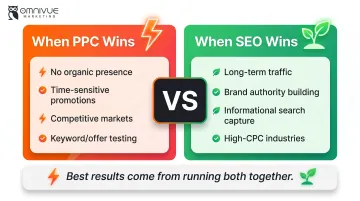
When PPC wins:
- New business with no organic presence
- Time-sensitive promotions (holiday sales, event registrations)
- Competitive markets where organic ranking is slow
- Testing which keywords and offers convert before investing in SEO content
When SEO wins:
- Long-term traffic generation without ongoing ad spend
- Building brand authority and trust
- Capturing informational searches early in the buyer journey
- Industries with extremely high CPCs where organic rankings offer better ROI
The Case for Running Both Together
PPC data (high-performing keywords, winning ad copy, best-converting landing pages) directly informs SEO strategy. Paid and organic listings together create a "halo effect" where 89% of search ad clicks are incremental, meaning they wouldn't have been captured by organic listings alone. Even when a brand ranks #1 organically, 50% of those ad clicks are still incremental.
PPC can fund itself through conversions while SEO builds in the background. Start with PPC to generate immediate revenue, then reinvest a portion of that revenue into SEO for long-term stability.
DIY vs. Hiring a PPC Management Agency
What DIY PPC Actually Requires
Managing PPC in-house successfully requires daily or weekly monitoring, keyword research skills, conversion tracking setup, A/B testing discipline, and platform fluency. The learning curve is real, and mistakes during the learning phase cost money, often more than management fees would have.
Common DIY mistakes:
- No conversion tracking setup (you're flying blind)
- Never adding negative keywords (wasting 20% to 40% of budget on irrelevant clicks)
- Setting campaigns and not checking them for weeks
- Ignoring Quality Score and landing page optimization
- Bidding too high because you don't understand auction mechanics
29% of Google Ads accounts record zero conversions over 90 days, often because conversion tracking was never configured. 25% of businesses have not added a single negative keyword. These aren't edge cases, they're common failures that waste thousands of dollars.
What Professional PPC Management Provides
Agencies bring proven campaign structures, industry benchmarks, cross-platform attribution, and time savings that free you to run your business. Google Partner status, for instance, requires managing at least $10,000 in ad spend over 90 days, maintaining a 70%+ optimization score, and certifying 50%+ of strategists, a baseline that filters out generalists.
A qualified agency manages the full path from click to conversion. That means landing page recommendations, conversion tracking setup, audience segmentation, bid strategy testing, and reporting that ties ad spend directly to revenue.
Vetting an Agency
Once you understand what good management looks like, the vetting process gets much easier. Look for:
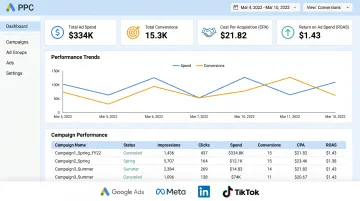
- Dashboards that show spend, conversions, CPA, and ROAS, not just vanity metrics
- Month-to-month or quarterly contracts without punishing exit clauses
- Flat or percentage-of-spend pricing with no buried "consulting fees"
- Demonstrated experience in your industry, not just general ad management
Omnivue Marketing, a Google Partner collective built for small and mid-sized businesses, is one example of this model in practice. Their proprietary OmniTrack Analytics Platform connects ad spend to actual revenue across channels, so you can see which campaigns are driving customers, not just clicks. The team maintains an 87% average client satisfaction score across their managed accounts.
Frequently Asked Questions
What is the average PPC management fee?
Most agencies charge either a flat monthly retainer ($500 to $2,500+ for small businesses) or a percentage of ad spend (typically 10% to 20%). Performance-based models exist but are less common. Expect to pay $1,000 to $1,500 monthly for professional management of a $2,000 to $3,000 ad budget.
Is $10 a day enough for PPC (Google Ads)?
No. At $10 per day ($300/month), you might only receive 1 to 3 clicks in industries with average CPCs of $3 to $7. Campaigns running on less than $300 per month generate so few clicks that optimization becomes impossible. A more practical starting budget is $1,000 to $1,500 monthly for low-competition niches, $2,000 to $3,000 for competitive industries.
Does PPC management work for small businesses?
Yes. PPC works well for small businesses because of budget control, targeting precision, and measurability, 84% of small businesses report good results from PPC campaigns. Results depend on management quality as much as spend: a well-optimized $2,000 campaign will outperform a poorly managed $5,000 one.
Is PPC management harder than SEO?
PPC has a faster learning curve with immediate feedback loops, but requires continuous active management. SEO is slower with delayed feedback but builds compounding results over time. Both have complexity that rewards expertise. PPC mistakes cost money immediately; SEO mistakes cost you months of lost opportunity.
How long does it take to see results from PPC?
Traffic can start within hours of launch, but meaningful, optimized results typically take 30 to 90 days as campaigns gather conversion data and undergo refinement. Expect the first 30 days to be testing and learning, with stabilized performance emerging around the 60 to 90-day mark.
What is the most important metric to track in a PPC campaign?
Focus on cost-per-acquisition (CPA) and conversion rate, not CTR or CPC. Cheap clicks that never convert still lose money. Compare your CPA against customer lifetime value to determine whether the campaign is actually profitable.